
The Missing Intelligence Layer
Why Microsoft Copilot Needs a Data Companion to Scale from Pilot to Production
Back to White PapersExecutive Summary: The AI Paradox of 2026
Enterprise AI has never been more powerful—or more paralyzed. Two-thirds of organizations surveyed in 2024 report their GenAI deployments stalled in "pilot purgatory," failing to progress beyond limited, proof-of-concept phases despite multi-million-dollar investments in platforms such as Microsoft Copilot.
The paradox: the "engine" (large language models such as GPT-4 and Azure OpenAI) has achieved remarkable capability, yet the "fuel" (enterprise data) remains largely unusable. Across the Fortune 500, up to 60 percent of data sits in unstructured silos—Windows and Linux file shares, SharePoint libraries, legacy archives—without the metadata, classification, or policy alignment necessary for AI to reason over it safely.
"The failure mechanism is rarely the AI model itself. It is the data—dark, unclassified, policy-orphaned—that prevents AI from delivering reliable, auditable, and valuable outcomes."
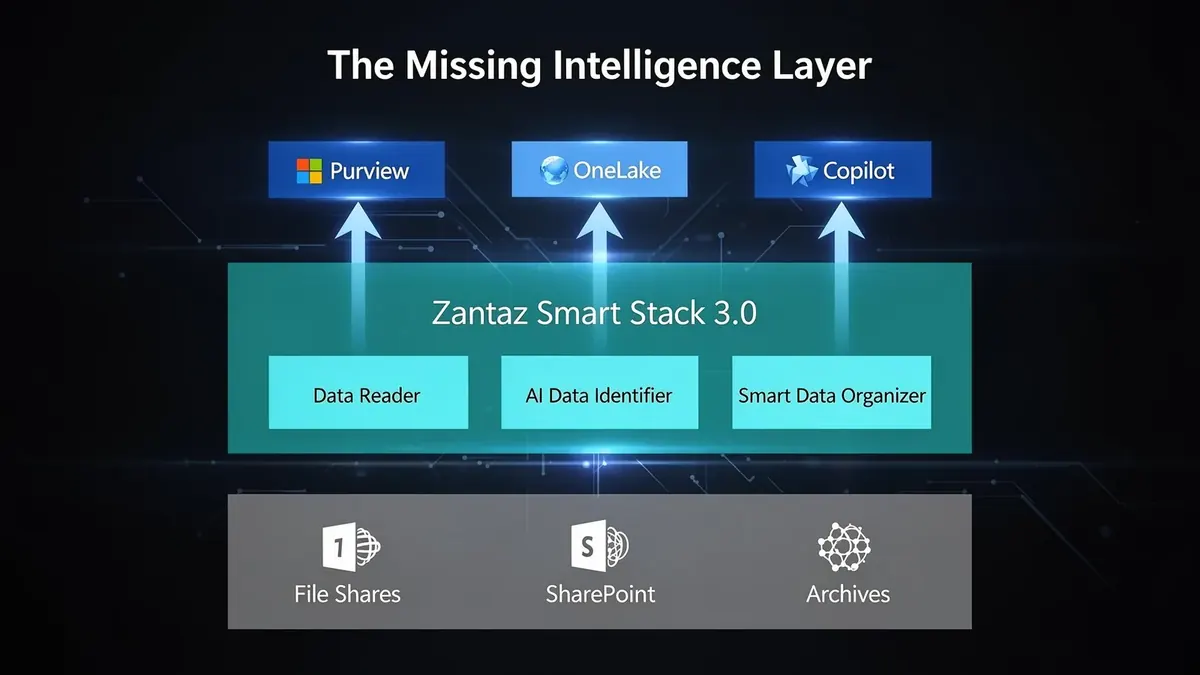
This research establishes a new category of enterprise architecture: the Microsoft Companion. Rather than replacing Microsoft platforms, a Companion sits "upstream" of Purview, OneLake, and Copilot, transforming chaotic Dark Data into AI-Ready Smart Data before the intelligence layer ever touches it. The result is faster Copilot adoption, stronger governance, reduced hallucination risk, and measurable ROI—measured not in years, but in quarters.
The Crisis of Scale: When "Garbage In, Garbage Out" Becomes Enterprise Policy
The phrase "garbage in, garbage out" has been an IT truism for decades, but the emergence of large language models (LLMs) has weaponized the adage. In 2025, a joint study by MIT Sloan and Boston Consulting Group reported that 95 percent of GenAI pilots failed to deliver measurable business impact—not because the models underperformed, but because the data they consumed was inconsistent, duplicated, incorrectly classified, or altogether absent from governance frameworks.
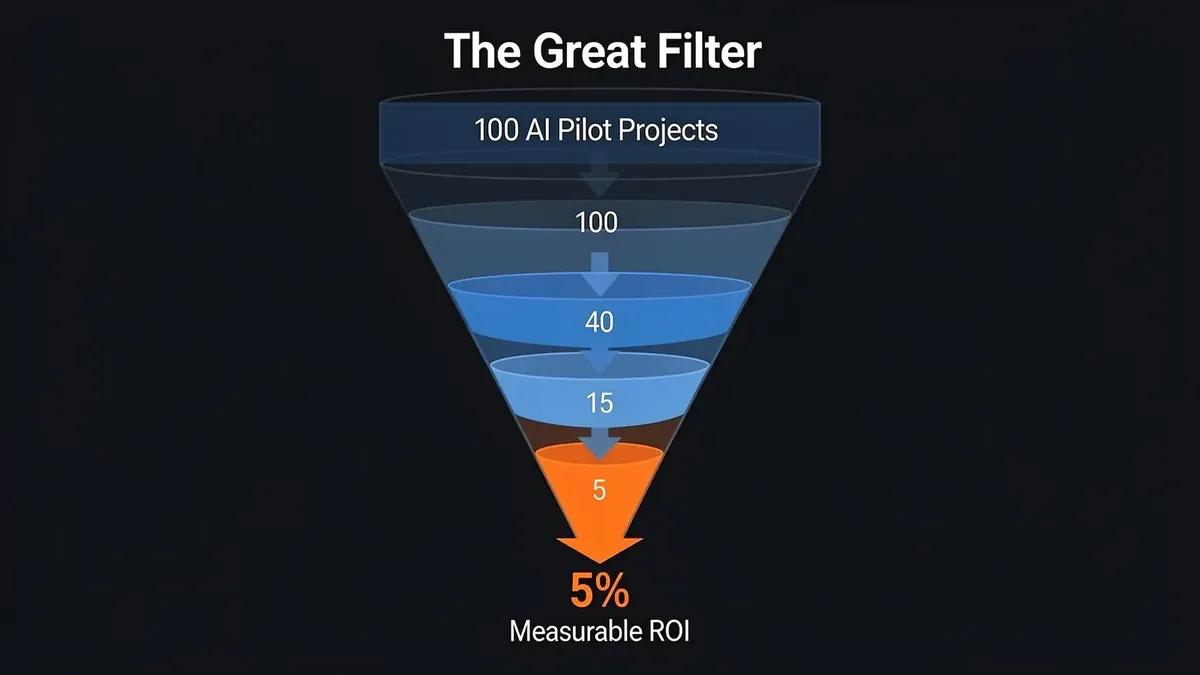
Three Failure Modes Dominate Enterprise AI
1. Hallucination Amplification
When an LLM is presented with contradictory or incomplete data, it "invents" plausible-sounding answers. In regulated industries—finance, healthcare, legal—a single hallucinated response can trigger compliance violations, litigation, or reputational harm. Research from Stanford HAI (2024) found that hallucination rates on enterprise tasks averaged 12–18 percent when models drew on unstructured file-share content that lacked metadata context.
2. Context Rot
Large context windows (128 K tokens and beyond) promised to solve the "lost context" problem. Instead, they exacerbated it: when an organization's file share contains millions of outdated versions, orphaned drafts, and duplicate files, an LLM's retrieval-augmented generation (RAG) pipeline surfaces contradictory documents with equal confidence. The model's output becomes a "mosaic of confusion" rather than a single source of truth.
3. Security via Obscurity Failure
Many enterprises relied historically on the difficulty of finding sensitive data as an informal security measure. AI obliterates this assumption: a Copilot query such as "summarize all HR performance reviews from the last two years" can surface terabytes of confidential material if access controls are not precisely aligned with sensitivity classifications.
The Shadow AI Economy: Cultural Resistance and Unsanctioned Tools
Enterprise IT departments are not the only actors shaping AI adoption. According to Gartner (March 2024), 38 percent of employees admit to using unsanctioned AI tools—copying corporate data into ChatGPT, Claude, or Gemini interfaces to bypass limitations of official Copilot deployments that have been locked down due to data-quality concerns.
The feedback loop is vicious: Leadership restricts Copilot access because data is ungoverned → employees turn to "shadow AI" → sensitive data exfiltrates to third-party clouds → security teams impose even stricter policies → employees find new workarounds.
"Shadow AI use adds $670,000 to the average US breach—a hidden tax on organizations that fail to provide governed AI alternatives."
Breaking this cycle requires not policy alone but a technical architecture that ensures Copilot can safely access the data employees actually need. Until that architecture exists, shadow AI will remain the path of least resistance.
The Economic Burden of Dark Data: The Double Tax
Dark Data—files that are stored but never accessed, understood, or governed—impose a "double tax" on enterprise IT budgets:
Storage Tax
According to IDC, global data volumes reached 180 zettabytes in 2025, with 55–60 percent classified as Dark Data. For an enterprise with 1 petabyte of unstructured storage, industry averages suggest 600 TB may be ROT (Redundant, Obsolete, Trivial) content that incurs storage costs without delivering value. At Microsoft 365 overage rates ($0.20/GB/month for SharePoint), that represents $1.44 million in annual waste.
Compute Tax
Every Copilot query, RAG retrieval, or analytics job that scans unfiltered Dark Data burns tokens, GPU cycles, and egress bandwidth. A 2024 survey by Andreessen Horowitz found that85 percent of enterprises exceeded their AI compute budgets in the first year of deployment, with "noisy data" cited as the leading cause.
Key Statistics: The Dark Data Burden
- • 180 zettabytes of global data in 2025
- • 55-60% classified as Dark Data
- • $1.44M annual waste on 1 PB of ROT storage
- • 85% of enterprises exceeded AI compute budgets
Environmental and Security Externalities
Environmental Impact
The carbon and water footprint of enterprise AI is often overlooked. The International Energy Agency estimates that data-center electricity demand will double by 2030, driven largely by AI workloads. Dark Data amplifies this impact: every unnecessary query, every duplicated file scanned, every outdated document indexed consumes energy.
Research from the University of Massachusetts Amherst (2024) found that training a single large language model can emit CO₂ equivalent to the lifetime emissions of five automobiles. Inference at enterprise scale—when models query unoptimized datasets—adds ongoing load.
Security Breach Costs
The average cost of a data breach in the United States reached $10.22 million in 2024, per the IBM Cost of a Data Breach Report. Shadow AI usage adds an additional $670,000 on average when employees exfiltrate data to unsanctioned tools. Organizations that cannot offer a safe, governed AI experience inadvertently subsidize future breach remediation.
"The average US data breach costs $10.22 million—and shadow AI adds $670,000 more. Dark Data governance is breach prevention."
The Architecture Gap: Why Native Microsoft Tools Are Necessary but Insufficient
Microsoft Purview is the de facto governance platform for Microsoft 365 and Azure environments. It provides sensitivity labeling, retention policies, data-loss prevention (DLP), and audit logging. Yet Purview was designed for a different era—one where data resided primarily in Exchange mailboxes and SharePoint document libraries, and where governance was synonymous with policy publication rather than policy execution.
The "Paper Governance Trap"
A 2024 survey by the Association for Information and Image Management (AIIM) found that72 percent of organizations have published data-governance policies that are not systematically enforced. Purview can define a retention rule ("delete marketing drafts after three years"), but it cannot locate and apply that rule to millions of unnamed, unclassified files scattered across legacy file shares.
Technical Limitations with Massive Unstructured Content
- Label Dependency: Purview's classification engine relies on content inspection at the time of labeling. If files were created before labeling policies existed—or if they reside on non-SharePoint file shares—they remain invisible to Purview's governance scope.
- Ownership Orphaning: Active Directory integration in Purview assumes files have current owners. In practice, employee turnover leaves vast swaths of content "orphaned," with no accountable owner to manage retention or disposition.
- Throughput Constraints: Purview scanning is optimized for M365-native content. A 500-million-file Windows file share cannot be indexed in a timeframe acceptable for urgent legal holds or compliance audits.
OneLake: The Promise and the Peril of a Unified Data Lake
Microsoft Fabric's OneLake offers a compelling vision: a single logical lake across all Azure workloads, enabling unified analytics and AI. Yet without upstream data preparation, OneLake risks becoming a "data swamp" rather than a data lake.
Shortcuts Virtualize Chaos
OneLake Shortcuts allow organizations to virtualize external data (S3 buckets, ADLS Gen2, on-premises file shares) into OneLake without physical data movement. This is efficient, but it means OneLake inherits all the classification gaps, ROT content, and policy orphans of the source systems.
"A data lake without upstream refinement is just a data swamp with better branding. OneLake needs a 'Clean Lake' architecture powered by a Microsoft Companion."
Governance Bypass
OneLake's primary governance controls are inherited from the source—if a file share lacks sensitivity labels, OneLake cannot manufacture them. Organizations often discover after deployment that Copilot can query OneLake data that was never intended for AI consumption, triggering emergency lockdowns that negate the productivity gains Copilot was meant to deliver.
Defining the Microsoft Companion: A Category, Not Just a Product
A Microsoft Companion is a purpose-built architecture that extends Microsoft's native capabilities across three dimensions:
Upstream Intelligence
Analyzes, classifies, enriches, and organizes unstructured data before it reaches Purview, OneLake, or Copilot.
Governance Enablement
Prepares data so that Purview policies can be applied precisely and defensibly—not aspirationally.
AI Readiness
Ensures that only high-signal, policy-approved Smart Data feeds Copilot and enterprise AI workloads.
Zantaz Data Resources is the category's defining entrant. Its mission statement—"Make Microsoft AI work in the real world"—encapsulates the Companion philosophy: complement Microsoft, never compete.
"Zantaz is not a replacement for Microsoft services—it is an AI accelerator for Microsoft. We complement Purview, OneLake, and Copilot by preparing the data on which those platforms depend."
Smart Stack 3.0 Core Component: Smart Data Refinery
At the heart of the Companion architecture is the Smart Data Refinery—an integrated pipeline that transforms Dark Data into Actionable Smart Data at enterprise scale.
Data Reader: Speed at Scale
Zantaz's Data Reader connects to Windows and Linux file shares, SharePoint, and other repositories without moving data. Its architecture supports scanning at 8 million files per hour—enabling a billion-file estate to be inventoried in approximately one week.
Data Identifier: Ownership, Classification, Enrichment
- Active Directory Integration: Maps every file to a current owner, group, or department, restoring accountability lost through employee turnover.
- Sensitivity Detection: Identifies PII, PHI, PCI, and regulated content with pattern-based and ML-assisted classifiers.
- ROT Classification: Flags Redundant, Obsolete, and Trivial content for disposition—often 50–60 percent of total storage.
Smart Data Collections: Curated Intelligence
The output of the Data Identifier populates refreshable Smart Data Collections — curated groupings of enriched metadata such as "all PII files owned by former employees" or "all documents subject to legal hold." Every document included in a collection can be traced back to the logic that placed it there, making these collections explainable and defensible in legal and regulatory contexts.
Smart Stack 3.0 Core Component: Smart HUB
Smart HUB is the central intelligence brain and operational control plane of Smart Stack 3.0. It activates the Smart Data Collections produced by the Refinery, staging, governing, sharing, and operationalizing them across the enterprise and into Microsoft AI systems.
The Architecture: Elasticsearch, Nextcloud, and MCP
Smart HUB integrates three core technologies into a unified intelligence layer:
Elasticsearch
The metadata brain. Organizes enriched objects into Smart Data Collections — saved, refreshable sets that power Copilot utilization, eDiscovery, compliance, and retention routing.
Nextcloud
The controlled collaboration layer. Acts as the universal drop zone and secure staging ground — enabling curated dataset packaging, controlled distribution, and full audit trails for every upload and share.
MCP
The governed AI interface. The Model Context Protocol provides the standard agent and LLM interface, letting Copilot-style agents query collections, retrieve only authorized content, and maintain full provenance — preventing accidental exposure.
Data Mirroring: From HUB to OneLake
The AI-Ready Data Feeder, a Smart HUB tool, delivers AI-Ready Data through Smart Data Mirroring. Instead of blindly copying raw data, it mirrors only enriched, policy-aligned, high-signal data into Microsoft OneLake, Snowflake, or Databricks — ensuring Copilot and analytics tools operate efficiently without processing data noise. By filtering out the 50–60 percent of storage that is ROT and applying sensitivity controls, early deployments report hallucination-rate reductions of up to 40 percent when using refined data versus raw file-share content.
Smart HUB: Five Core Actions
- • Mirror — project approved Smart Data Collections into OneLake or Snowflake via pointer-based reflection
- • Move — orchestrate controlled movement into governed environments like LegalHUB or AI-Ready Archives
- • Copy — create controlled copies with access controls, expiration, and audit logging
- • Delete — trigger secure, auditable deletion of redundant, obsolete, or expired data
- • Store — route data long-term to the appropriate archive, workspace, or analytics platform
Smart Stack 3.0 Core Component: Smart Data Archive
Enterprise communications—email, Teams messages, collaboration artifacts—require a separate governance track. Microsoft Exchange Online cannot natively serve as a compliant journal destination, and Purview is explicitly not a system of record for regulatory retention.
Regulatory Alignment
Zantaz's Smart Data Archive suite (EAS, HPCA, Z Cloud, Arcivium for Azure) captures communications in real time, preserving full journal envelopes—BCC recipients, distribution-list expansions, routing metadata—that SEC 17a-4, FINRA, FCA, MiFID II, and HIPAA auditors require.
Arcivium for Azure: Azure-Native Compliance
Arcivium is the first Azure-native compliant journaling framework, deploying entirely within a customer's Azure tenant using Blob Storage, Azure SQL, and Azure Web Apps. This architecture:
- Consumes Azure committed spend (MACC alignment)
- Supports geo-dispersed storage for data-sovereignty compliance
- Reduces dependency on costly E5 licensing for compliance-only use cases
"Arcivium does not compete with Microsoft Purview; it completes it. Purview governs and analyzes. Arcivium preserves."
Economic Model: The $1 Million Enterprise License and ROI Validation
Zantaz's Smart Stack 3.0 is delivered under a fixed-cost, $1 million annual enterprise license with unlimited users and unlimited usage. This pricing philosophy reflects a fundamental critique of prevailing enterprise-software economics.
Fixed-Cost Predictability vs. Usage Spiral
Most AI and governance platforms charge per-user, per-GB, or per-query fees. As AI adoption scales, costs scale superlinearly—often surprising CFOs with 200–300 percent budget overruns. Zantaz's fixed-cost model eliminates this uncertainty:
- Deploy across all employees without seat-count anxiety
- Ingest and refine petabytes without overage penalties
- Scale Copilot and analytics workloads without compute surcharges
Included Systems Integrator
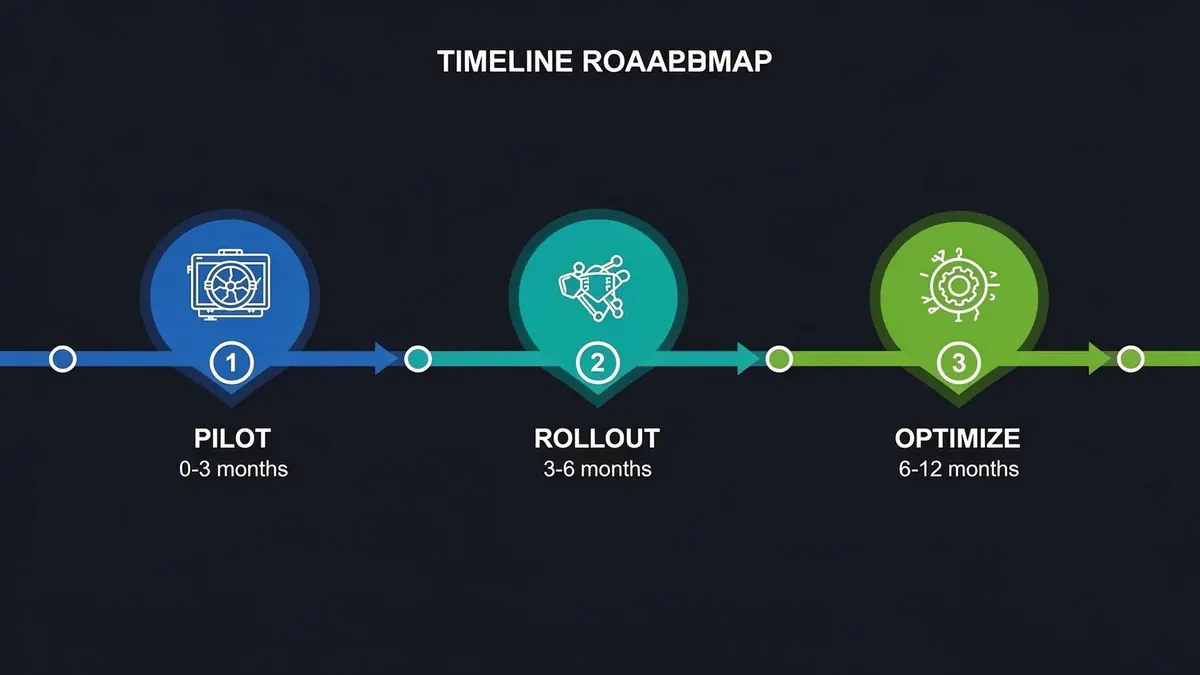
The $1 million license includes a nine-month embedded Systems Integrator engagement, ensuring rapid deployment, integration with existing Microsoft investments, and knowledge transfer to internal teams.
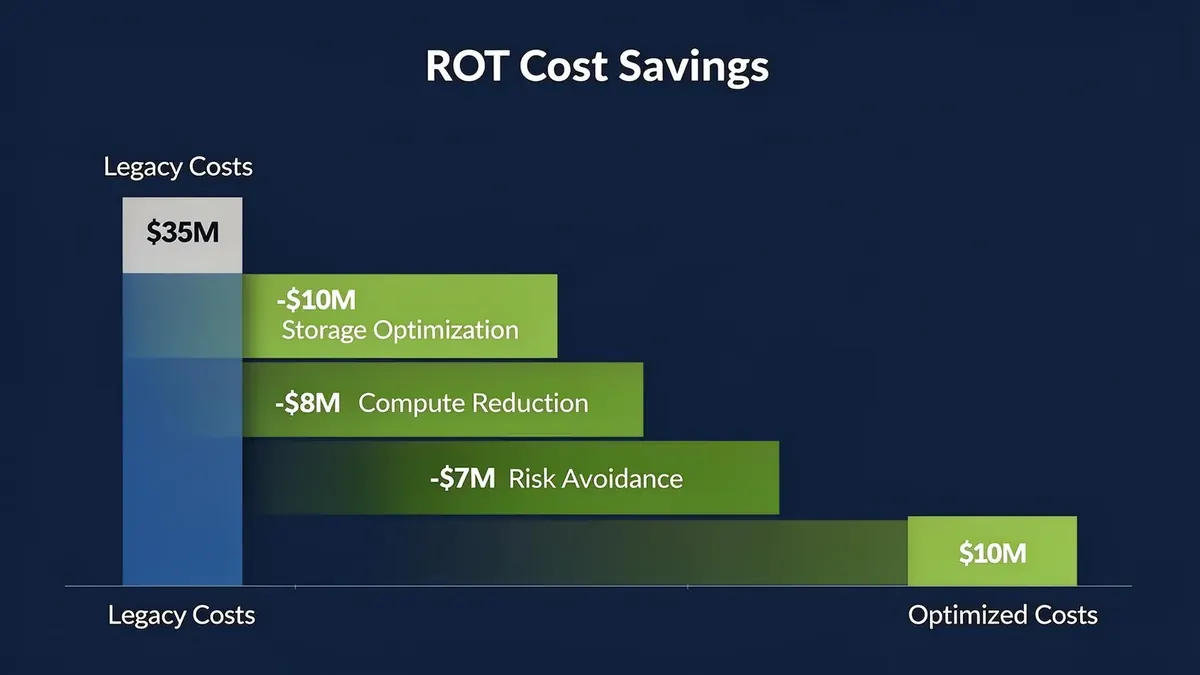
Cost Avoidance Analysis: Storage, Compute, and Risk
Storage Optimization
A 1-petabyte unstructured estate with 60 percent ROT content represents 600 TB of eliminable storage. At $0.20/GB/month (Microsoft 365 overage rate), annual savings reach $1.44 million—directly offsetting the license cost.
Token Savings
Every Copilot query that scans unrefined data burns tokens proportional to content volume. Reducing queryable data by 60 percent yields corresponding reductions in Azure OpenAI consumption—often measured in hundreds of thousands of dollars annually for large deployments.
Risk Abatement
With average US breach costs at $10.22 million and shadow-AI premiums adding $670,000, a single prevented breach can fund a decade of Companion licensing. Governance is not a cost center—it is insurance.
ROI Summary
$1.44M
Annual Storage Savings
40%
Token Cost Reduction
$10M+
Breach Prevention Value
Technical Synergy: Purview as Policy Authority, Companion as Policy Engine
The relationship between Purview and a Companion is symbiotic, not competitive:
| Capability | Purview | Zantaz Companion |
|---|---|---|
| Policy Definition | ✓ Defines labels, retention, DLP rules | Prepares data for policy application |
| Legacy File-Share Governance | Limited scanning capacity | ✓ 8M files/hour with full enrichment |
| Ownership Restoration | Assumes current ownership | ✓ AD integration, orphan remediation |
| ROT Elimination | Policy-based retention only | ✓ Proactive classification and disposition |
| Compliant Journaling | Not a system of record | ✓ SEC 17a-4, FINRA, HIPAA compliant |
When Zantaz enriches file-share data with ownership, sensitivity, and classification metadata, Purview can apply its policies with surgical precision—rather than attempting to govern a chaotic, unindexed wilderness.
Competitive Landscape: Why Legacy Solutions Fall Short
Legacy Archive Vendors (Smarsh, Global Relay, Mimecast)
These platforms excel at communications capture but were not designed for AI-era governance. They preserve data; they do not prepare it for Copilot, OneLake, or enterprise analytics. Migration paths are often complex, and licensing models penalize scale.
Backup and DR Vendors (Commvault, Cohesity, Rubrik)
"Bit-perfect" preservation is their mission—valuable for disaster recovery, but antithetical to AI readiness. Restoring a backup does not classify, enrich, or govern the restored data; it simply replicates chaos.
Data Catalogs and Observability Tools
Platforms like Alation, Collibra, and Monte Carlo provide visibility and lineage but do not transform data. They are "maps of the swamp," not "swamp-draining infrastructure."
"Legacy solutions preserve chaos. A Microsoft Companion transforms it. That distinction defines the AI era."
Snowflake and Databricks Interoperability
Smart Stack 3.0's Smart HUB supports Data Mirroring to Snowflake and Databricks environments, extending the Companion value proposition beyond Azure-native workloads. Organizations with multi-cloud analytics strategies can unify governance across platforms without forklift migrations or years-long implementation backlogs.
Conclusion: Strategic Recommendations for C-Suite Leadership
The AI paradox of 2026 will not be resolved by waiting for models to improve or for Microsoft to close every governance gap. It will be resolved by organizations that invest in the "fuel problem"—transforming Dark Data into AI-Ready Smart Data before AI workloads consume it.
C-Suite Action Items
- Audit Your Dark Data Estate: Quantify ROT, orphaned files, and unclassified sensitive content across file shares, SharePoint, and legacy archives.
- Implement Upstream Refinement: Deploy a Smart Data Refinery to classify, enrich, and organize unstructured data before it reaches Purview or OneLake.
- Shift to Fixed-Cost Licensing: Avoid usage-spiral economics by adopting predictable, unlimited-usage licensing models.
- Align with Purview, Don't Replace It: Use a Companion to make Purview's policies executable at scale—not to bypass them.
"Enterprises that win with Copilot know where their data is, reduce Dark Data, govern before they generate, and feed AI only what matters."
The Microsoft Companion Imperative
The Microsoft Companion is not a luxury—it is an architectural necessity for the AI era. Zantaz Data Resources' Smart Stack 3.0 provides the intelligence, governance-enablement, and AI-readiness layer that Microsoft's native tools require to operate at enterprise scale. The choice is not whether to adopt a Companion, but how quickly.
Works Cited
- AIIM. "State of the Intelligent Information Management Industry 2024." aiim.org/resources
- Andreessen Horowitz. "Enterprise AI Cost Survey 2024." a16z.com/ai-cost-survey
- Boston Consulting Group. "From Potential to Profit with GenAI." bcg.com/genai-2024
- Gartner. "Shadow AI and Employee Tool Usage Survey." gartner.com/research/shadow-ai
- IBM Security. "Cost of a Data Breach Report 2024." ibm.com/security/data-breach
- IDC. "Global DataSphere Forecast 2025-2029." idc.com/datasphere
- International Energy Agency. "Data Centres and Data Transmission Networks." iea.org/energy-system/buildings/data-centres
- MIT Sloan Management Review. "Why AI Projects Fail: A Strategic Analysis." sloanreview.mit.edu/ai-projects
- Microsoft. "Microsoft Purview Documentation." learn.microsoft.com/purview
- Microsoft. "OneLake and Microsoft Fabric Overview." learn.microsoft.com/fabric
- Stanford HAI. "Hallucination Rates in Enterprise LLM Deployments." hai.stanford.edu/research
- University of Massachusetts Amherst. "Carbon Footprint of Large Language Models." umass.edu/cs/ai-carbon
- Zantaz Data Resources. "Smart Stack 3.0 Technical Documentation." zantaz.com/smartstack
Related Reading
Enterprise AI Readiness
Comprehensive analysis of enterprise AI adoption challenges and the critical role of data readiness in successful Copilot deployments. Covers Dark Data economics, the Trusted Data Portal intelligence control plane, and the GE case study with $30M savings.
ResearchPrecision Governance
Strategic manifesto and technical roadmap for CISOs and CCOs addressing the Purview Paradox — how to govern exabytes of legacy data for safe AI deployment using the Trusted Data Refinery and Trusted Data Portal architecture.
Ready to Transform Your Data?
See how Zantaz's Smart Stack 3.0 can make your enterprise AI-ready.