
The Companion Program · Relativity Companion
Govern at the source. Review on what matters.
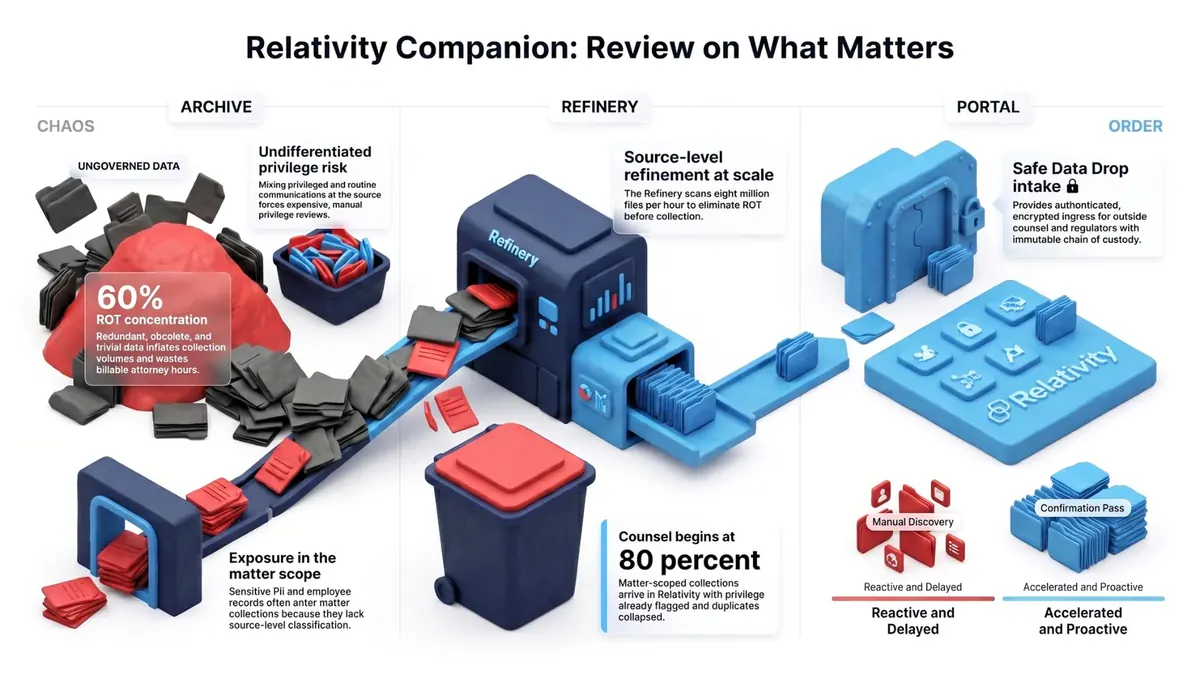
Relativity is the most powerful eDiscovery and legal review platform in the industry. The data feeding it almost always comes from the Microsoft estate, and almost always has never been governed. The Relativity Companion takes the matter-scoped Trusted Data Collections produced by Legal HUB and projects them into Relativity with privilege flagged, ROT eliminated, and chain of custody intact. Counsel begins at 80 percent completion.
The Problem This Companion Solves
Relativity sits at the center of modern eDiscovery. Law firms run their review on it. In-house legal departments run their investigations on it. Outside counsel coordinates document production through it. The platform itself is excellent. RelativityOne has scaled the architecture to the cloud. aiR for Review is bringing AI to the document review surface in defensible ways. The technology is not the bottleneck. The data is.
For most matters, the data feeding Relativity comes from the Microsoft estate. Custodian email collected from Exchange and M365. SharePoint sites and Teams channels associated with the matter. Windows File Shares holding the documents the custodians actually worked with. OneDrive accounts for departed employees whose retention holds have been triggered. The Microsoft estate is where the responsive content lives. It is also where almost none of the governance happens.
When a matter triggers, the legal team faces a choice that has not been a real choice for years. Collect everything that might be responsive and pay attorneys to review it all. Or collect a narrower scope and risk missing responsive content. Both options are bad. The result is review populations containing forty or fifty versions of the same negotiated document, near-duplicate correspondence threads reviewed in full, ROT that should never have been collected, and privileged content that has not been flagged at the source.
The cost is measured in attorney hours and review platform costs. ROT can account for up to 60 percent of the legal file estate. Every redundant version of every negotiated document that reaches attorney review is billable time wasted. The governance gap is not in Relativity. The gap is upstream, in the Microsoft estate. It has to be solved before data reaches the review platform.
Built for the executives who own the data estate
For the General Counsel
Outside counsel rates are not coming down. Review platform costs are not coming down. The only variable that changes the matter economics is what reaches review in the first place. The Trusted Data Refinery scans Windows File Shares, SharePoint, and OneDrive in place at eight million files an hour. ROT is eliminated before the review collection is built. Privilege is flagged at the source. By the time the matter collection arrives in Relativity, the ROT has been eliminated, privilege has been flagged, and the collection has been governed. Counsel begins at 80 percent completion. Per-gigabyte review costs fall proportionally to the ROT eliminated upstream. The matter timeline tightens. The budget defends.
For the CDO
The data feeding Relativity is the same data feeding Copilot, Fabric, Snowflake, Salesforce, and every other ecosystem the organization activates. Every governance investment the CDO makes pays back in legal review economics in addition to the AI economics. Trusted Data Collections produced by the Refinery flow into Relativity for legal review and into every other Companion ecosystem for AI activation. The same governance work serves both surfaces. The CDO governs once. Legal review benefits. AI initiatives benefit.
For the CISO
Legal review is one of the highest-exposure surfaces in the enterprise. Privileged content. Customer PII. Employee personal information. Financial account identifiers. Trade secrets. All of it concentrates in matter collections. All of it travels through outside counsel firms and review platforms outside the CISO's direct control. The Trusted Data Portal establishes an immutable chain of custody from the moment the first file enters Safe Data Drop. Sensitive Data Classification identifies customer PII and employee personal information at the source. Privileged content is flagged before the review collection leaves the Microsoft tenant. Classification metadata travels with every document through review and into production.
What the Trusted Data Toolkit Does for Relativity Companion
Trusted Data Archive
Provenance-Verified Custodian Communications
Captures every Exchange, M365, and Teams communication with full journal envelope preservation including BCC recipients, expanded distribution lists, and routing metadata. WORM-compliant immutable storage aligned to SEC 17a-4, FINRA, FCA, and MiFID II requirements. When opposing counsel challenges the completeness of a communications record, the Archive answers that challenge completely. Custodian email collections that flow into Relativity carry envelope metadata, evidentiary integrity, and chain of custody intact.
Trusted Data Refinery
Governed Matter Collections at the Source
Scans Windows File Shares, SharePoint, and OneDrive in place at eight million file objects per hour. ROT is eliminated before the review collection is built. Hash-based duplicate detection collapses redundant copies. Sensitive content is classified through Sensitive Data Classification. Attorney-client privileged content is flagged using pattern recognition and classification models. Trusted Data Collections are assembled by matter, by custodian, by privilege status, and by date range. Counsel receives a collection that has already been governed.
Trusted Data Portal
Universal Drop Zone for Matter Data
Safe Data Drop provides authenticated, encrypted ingress for outside counsel, regulators, and witness intake with an immutable chain of custody from the moment the first file is uploaded. Workflow Builder orchestrates Legal Hold Workflow, Regulatory Response Workflow, and matter intake consistently across every matter. Enterprise Search and eDiscovery span the Archive and Portal collections in a unified surface. Model Context Protocol enforcement ensures legal AI tools operate only on authorized, policy-aligned Trusted Data Collections.
Additional Toolkit Components
What Changes for the Relativity Environment
Govern at the source. Review on what matters.
Relativity Companion
Powered by Smart Stack 3.0