Zantaz Smart Stack 3.0™
Human Understanding Bandwidth™
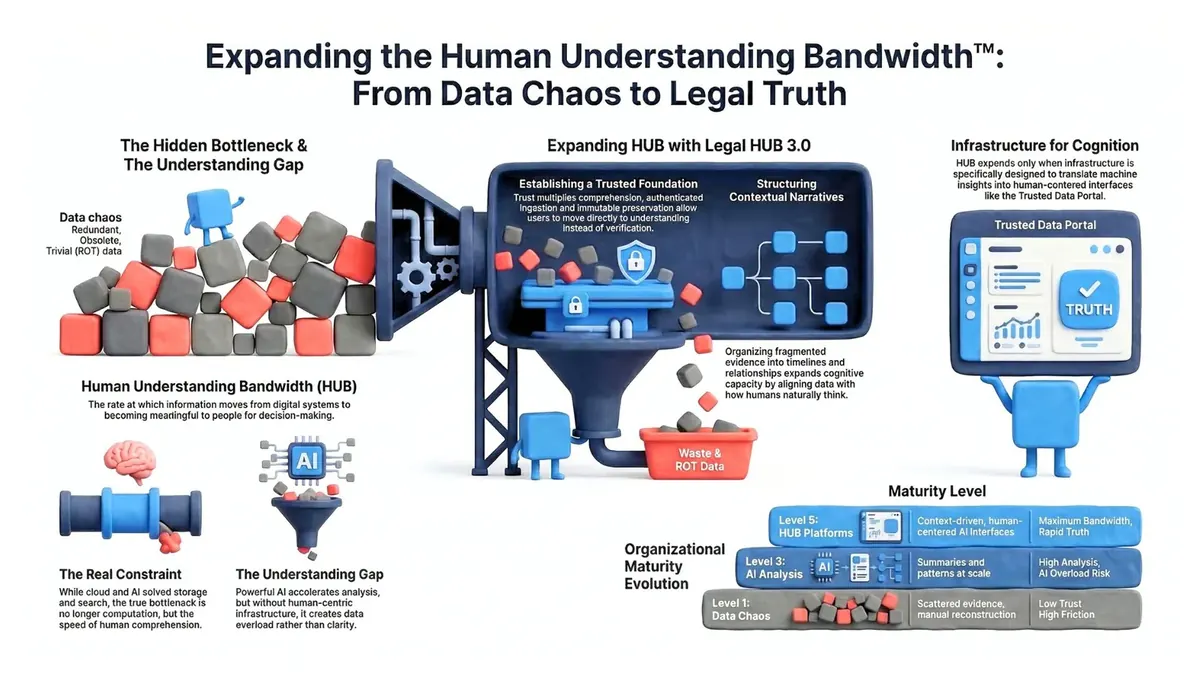
Expanding Human Understanding Bandwidth™ is the defining purpose of Zantaz Smart Stack 3.0. Smart Stack 3.0 transforms fragmented enterprise information into trusted, structured, AI-ready data so people can understand more, decide faster, and act with confidence.
The Five Laws of Human Understanding Bandwidth™
In the modern legal environment, expanding Human Understanding Bandwidth™ has become a strategic necessity. Organizations that expand HUB can understand evidence faster, reach decisions sooner, and act with greater confidence. Organizations that fail to expand HUB drown in data.
Law 1: Understanding Is the Real Bottleneck
For decades, the legal industry believed the primary challenge of digital evidence was storage and search. Technology solved those problems. Cloud infrastructure stores everything. Search engines locate anything instantly. AI analyzes millions of documents in seconds. Yet legal investigations still take months.
Because the real constraint is not storage, search, or analysis. The real constraint is human understanding. Every legal matter ultimately depends on people understanding facts, recognizing patterns, and exercising judgment. No matter how powerful machines become, the rate of legal decision-making is limited by the rate at which humans can understand digital evidence.
This is the first law of Human Understanding Bandwidth™: Understanding, not computation, is the true constraint of modern legal infrastructure.
Law 2: AI Increases the Understanding Gap
Artificial intelligence is often described as the solution to the complexity of modern data. In reality, AI also accelerates the problem. AI systems generate summaries, correlations, predictions, and insights at enormous scale.
But every insight still requires human interpretation. As AI analysis accelerates, the gap between machine output and human comprehension widens. The faster machines analyze information, the more humans risk becoming overwhelmed by the results. This creates what we call the Understanding Gap.
The second law of Human Understanding Bandwidth™ is therefore: The more powerful AI becomes, the more important human understanding infrastructure becomes. Without systems designed to translate AI insights into human comprehension, AI does not produce clarity. It produces overload.
Law 3: Trust Precedes Understanding
Humans cannot understand information they do not trust. When evidence lacks authentication, provenance, or chain of custody, investigators cannot focus on interpretation. They must first focus on verification. Every moment spent questioning the integrity of evidence reduces Human Understanding Bandwidth™. Trust is therefore not simply a legal requirement. It is a prerequisite for comprehension.
The third law of Human Understanding Bandwidth™ is: Trusted data multiplies the rate at which humans can understand information. Infrastructure that guarantees data integrity dramatically increases the speed of human decision-making.
Law 4: Context Multiplies Comprehension
Human cognition is not optimized for isolated documents. Humans understand information through context. We recognize patterns through timelines. We interpret meaning through relationships. We comprehend events through narrative.
Traditional legal technology often presents evidence as fragmented documents, forcing investigators to reconstruct context manually. This dramatically limits Human Understanding Bandwidth™. When information is organized into structured context, timelines, conversations, relationships, and investigative narratives, humans can process meaning far more rapidly.
The fourth law of Human Understanding Bandwidth™ states: Structured context multiplies human comprehension. Technology that organizes evidence into meaningful context dramatically expands understanding capacity.
Law 5: Understanding Requires Infrastructure
Understanding is often treated as a purely human activity. In reality, understanding depends on infrastructure. Just as networks expanded communication bandwidth and cloud platforms expanded computing bandwidth, modern organizations require infrastructure designed specifically to expand Human Understanding Bandwidth™. That infrastructure must establish trusted data, structure information into context, and translate machine insights into human comprehension.
This is the final law: Human Understanding Bandwidth™ expands when infrastructure is designed specifically to support human cognition.
How Smart Stack 3.0 Expands Human Understanding Bandwidth™
Smart Stack 3.0 was designed to comply with these five laws. It establishes trusted digital evidence. It structures that evidence into investigative context. It presents insights through the Trusted Data Portal, where humans can explore information naturally. The result is not simply faster data processing. It is faster human understanding.
Smart Stack expands that bandwidth by removing the three primary constraints that prevent humans from understanding digital evidence quickly: Untrusted Data, Unstructured Context, and Fragmented Access to Information.
Establishing Trust Before Understanding
Human understanding begins with confidence in the authenticity of information. Attorneys cannot interpret evidence effectively if they must constantly question whether the data has been altered, miscollected, or corrupted. When trust is uncertain, every document requires verification, which dramatically slows comprehension.
Smart Stack 3.0 solves this by establishing a Trusted Data Foundation: authenticated ingestion of enterprise data, immutable preservation of original evidence, complete chain-of-custody tracking, and governance aligned with legal standards. Because users know the data is trusted, they can move directly to understanding rather than verification. This alone dramatically expands Human Understanding Bandwidth™.
Structuring Evidence Into Comprehensible Context
Digital evidence typically exists in chaotic forms such as email threads, chat fragments, attachments, file shares, and cloud collaboration artifacts. Even when AI analyzes this information, the results often remain fragmented. Smart Stack 3.0 organizes this evidence into a structured investigative context with unified timelines, conversation reconstruction, relationship mapping, and matter-centric organization.
Instead of examining isolated documents, investigators can understand narratives, sequences, and patterns. This structural organization converts information into meaning, which directly expands Human Understanding Bandwidth™.
The HUB Maturity Model
The maturity model shows how organizations evolve in their ability to convert digital evidence into understanding.
Level 1: Data Chaos
Organizations possess massive volumes of digital information but little structure. Evidence is scattered across email systems, file shares, cloud platforms, messaging systems, and external storage. Investigations require manual collection and reconstruction. Understanding capacity is extremely limited. Low trust. Low context. High friction.
Level 2: Data Collection
Organizations begin implementing eDiscovery platforms and data collection tools. Evidence can now be gathered and searched. However, information is still largely document-centric and fragmented. Investigators spend enormous amounts of time reconstructing narratives from individual documents. Moderate trust. Minimal context. Moderate friction.
Level 3: AI Analysis
Organizations introduce AI tools for document classification, summarization, and pattern detection. Machine insights increase dramatically. However, AI outputs often overwhelm human users. Understanding improves somewhat but cognitive overload becomes a new challenge. High analysis. Low comprehension. AI overload risk.
Level 4: Understanding Infrastructure
Organizations deploy systems specifically designed to organize trusted data into an investigative context. Evidence becomes structured around timelines, conversations, relationships, and investigative matters. AI insights are translated into structured human understanding. This is the stage where Human Understanding Bandwidth™ begins expanding dramatically.
Level 5: Human Understanding Platforms
At the highest level, organizations operate platforms designed specifically to maximize Human Understanding Bandwidth™. These platforms provide trusted evidence foundations, context-driven investigative environments, and human-centered AI interfaces. Legal professionals can explore complex digital evidence rapidly and intuitively. Investigations accelerate. Decision-making improves. Truth emerges faster.
Where Smart Stack 3.0 Fits
Smart Stack 3.0 is designed for Level 4 and Level 5 organizations. It provides a trusted evidence infrastructure, a structured investigative context, and the Trusted Data Portal for human exploration of digital truth. AI accelerates analysis. Smart Stack accelerates understanding.
The next generation of legal technology will not be defined by faster AI. It will be defined by infrastructure that expands Human Understanding Bandwidth™. And that is exactly what Smart Stack 3.0 was built to do.
The Future of Legal Infrastructure
For decades, legal technology has focused on collecting data, storing documents, and accelerating review. The next era of legal technology will focus on something more fundamental: understanding.
The organizations that succeed will not simply accumulate information. They will build systems that enable humans to understand that information at scale. The future of legal technology will therefore be defined by one question: How effectively does your infrastructure expand Human Understanding Bandwidth™?
The legal profession ultimately depends on human judgment. Technology can surface insights. But only humans can understand them. The next generation of legal infrastructure must therefore focus on one fundamental objective: Expanding Human Understanding Bandwidth™. And that is exactly what Smart Stack 3.0 was built to do.
Key Benefits
- Understanding Is the Bottleneck: The rate of legal decision-making is limited by the rate at which humans can understand digital evidence, not by computation.
- AI Widens the Gap: As AI generates more insights, the gap between machine output and human comprehension grows. Infrastructure must bridge it.
- Trust Multiplies Speed: Trusted data with proven provenance eliminates verification overhead, dramatically accelerating human comprehension.
- Context Drives Comprehension: Structured timelines, relationships, and narratives enable humans to process meaning far more rapidly than isolated documents.
Conclusion
Zantaz Data Resources is pioneering Human Understanding Bandwidth™ as the defining category for the next generation of legal infrastructure. Smart Stack 3.0 is the infrastructure that expands Human Understanding Bandwidth™, and the Trusted Data Portal is where that expanded bandwidth becomes visible to human investigators. Together, they transform overwhelming digital evidence into understandable truth.