
The Companion Program · Salesforce Companion
Your CRM is only as defensible as the records behind it.
Salesforce is where revenue is run. The records that justify revenue, the contracts, communications, customer documents, and matter files, live in the Microsoft estate. Smart Stack 3.0 governs them before they ever inform a Salesforce decision or a Salesforce AI prompt.
The Problem This Companion Solves
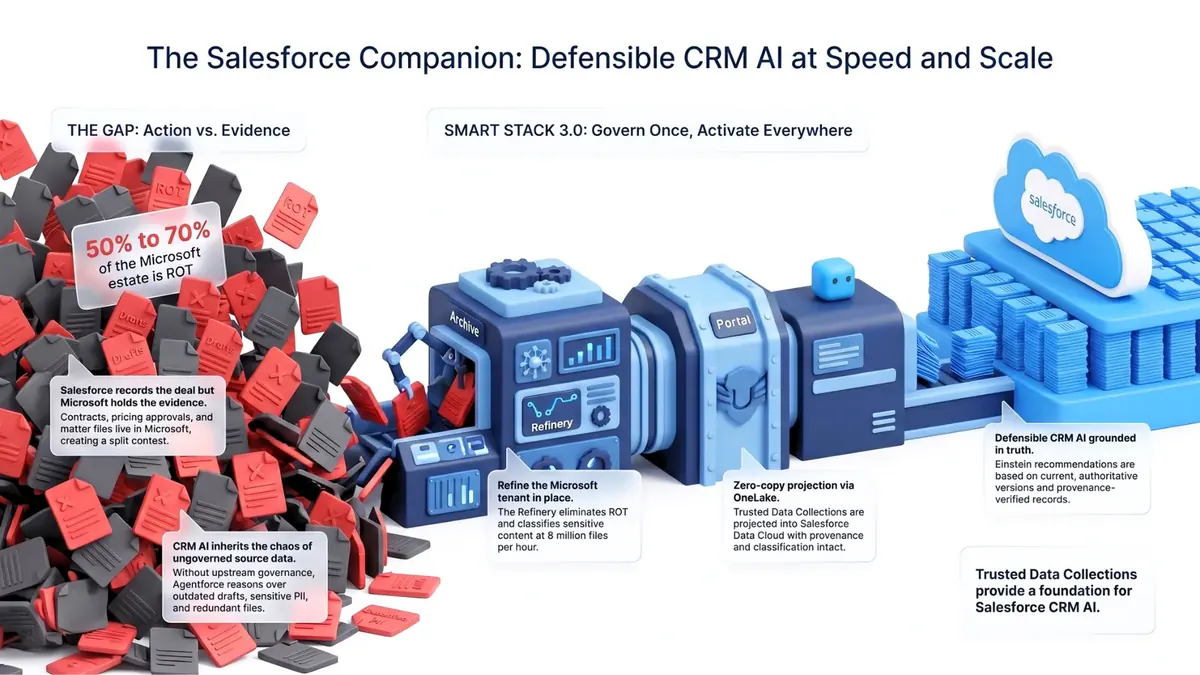
Salesforce is the system of action for revenue. It is not the system of record for the documents and communications that justify that action. Contracts are negotiated in email and Word. Customer matters are documented in SharePoint. Pricing approvals live in Teams threads. Account intelligence is scattered across file shares and OneDrive.
Without governance upstream, every Agentforce prompt or Einstein recommendation that touches Microsoft-resident content inherits whatever Dark Data and Dirty Data are sitting there. Customer PII surfaces in places it should not. Privileged communications get exposed. Outdated contract versions get treated as authoritative.
The governance gap is in the Microsoft estate, upstream of Salesforce.
Built for the executives who own the data estate
For the CDO
Salesforce is asking the customer record to carry the weight of every revenue decision the organization makes. The data that justifies those decisions does not live in Salesforce. It lives in the Microsoft estate. The Trusted Data Refinery classifies the Microsoft file estate by account, matter, region, or business unit. Trusted Data Collections become the governed customer context that flows into the Salesforce Data Cloud and Agentforce environment. The customer record becomes traceable to its source documents.
For the CIO
Sales operations and revenue leaders are asking for CRM AI that incorporates the full customer context. Building that context by hand, account by account, is not scalable. Building it from ungoverned Microsoft sprawl is not safe. The Trusted Data Portal routes governed customer, contract, and communications context through OneLake into Salesforce. One pipeline. One governance model.
For the CISO
Customer PII is the most regulated data class your organization handles. It does not stay neatly inside the transactional CRM. It migrates into customer email threads, contract attachments, support documents, and matter files across the Microsoft estate. Sensitive Data Classification identifies customer PII inside the Microsoft estate before it reaches Salesforce. The AI Governance Workflow ensures only policy-aligned content reaches Agentforce or Einstein.
What the Trusted Data Toolkit Does for Salesforce Companion
Trusted Data Archive
Defensible Customer Communications
Captures the customer-facing communications layer with envelope preservation, WORM retention, and evidentiary audit trails. Customer email threads, Teams negotiations, and contract correspondence become defensible records that CRM AI can reason over without exposure risk.
Trusted Data Refinery
Account-Aligned Document Intelligence
Classifies the Microsoft file estate to identify customer PII, contract documents, signed agreements, and matter-specific files. Sensitive data is governed. ROT is eliminated. Trusted Data Collections are assembled by account, matter, region, or business unit.
Trusted Data Portal
Governed Routing into Salesforce
Routes Trusted Data Collections through OneLake into the Salesforce Data Cloud and Agentforce environment. The AI Governance Workflow ensures only policy-aligned, provenance-verified content reaches CRM AI surfaces.
What Changes for the Customer
Salesforce runs revenue. The Companion makes it defensible.
Salesforce Companion
Powered by Smart Stack 3.0