
Own The Intelligence, Govern The Data
Open-weight AI lets an enterprise run the model inside its own environment. That choice only pays off when the information the model reaches is already trusted. This guide shows how the two decisions fit together.
WATCH THE VIDEO
What An Open-Weight Model Actually Is
An open-weight model is an AI system whose underlying intelligence can be downloaded, installed, and operated inside the customer environment. The organization is not renting access to a service it cannot see. It is running the intelligence itself, on infrastructure it controls, under policies it sets.
The distinction is control. Where the model runs, what it may access, how it is adapted, and who may ask it questions all become enterprise decisions. That is why regulated industries and public sector organizations are moving toward this posture.
Rented Intelligence or Resident Intelligence
Flip the switch to see how each control dimension changes.
Where The AI Runs
Inside the customer environment, under customer control.
Inside the provider environment, under provider terms.
Inside the customer environment, under customer control.
What It Can Access
Only the approved information the enterprise chooses to expose.
Whatever is sent to the service, shaped by provider interfaces.
Only the approved information the enterprise chooses to expose.
How It Is Customized
Adapted to the organization, its language, and its use cases.
Limited to the tuning options the provider exposes.
Adapted to the organization, its language, and its use cases.
Security And Privacy
Governed by enterprise identity, network, and policy controls.
Governed by provider policy and shared service boundaries.
Governed by enterprise identity, network, and policy controls.
Cost Posture
Infrastructure cost the enterprise sizes and owns.
Consumption pricing tied to provider rate changes.
Infrastructure cost the enterprise sizes and owns.
Provider Switching
Models can be replaced without rebuilding the data foundation.
Migration effort grows with every dependency added.
Models can be replaced without rebuilding the data foundation.
Traditional AI is a skilled employee working in someone else's building. Open-weight AI brings that employee into your building, on your terms.
Open-Weight Is Not The Same As Open-Source
The distinction matters in procurement, security review, and regulatory conversations.
Trained Weights
Available
The model can be downloaded, installed, and operated inside the customer environment.
Training Data
Often Private
The information used to train the model may never be published by the model developer.
Source Code
Sometimes Private
Open-weight does not automatically mean open-source. Development process and code may remain closed.
Intelligence Is Not The Constraint
A powerful model placed on top of a disorganized estate produces confident answers built on incomplete, duplicated, or restricted content. Bringing the model in-house does not solve that. It relocates it.
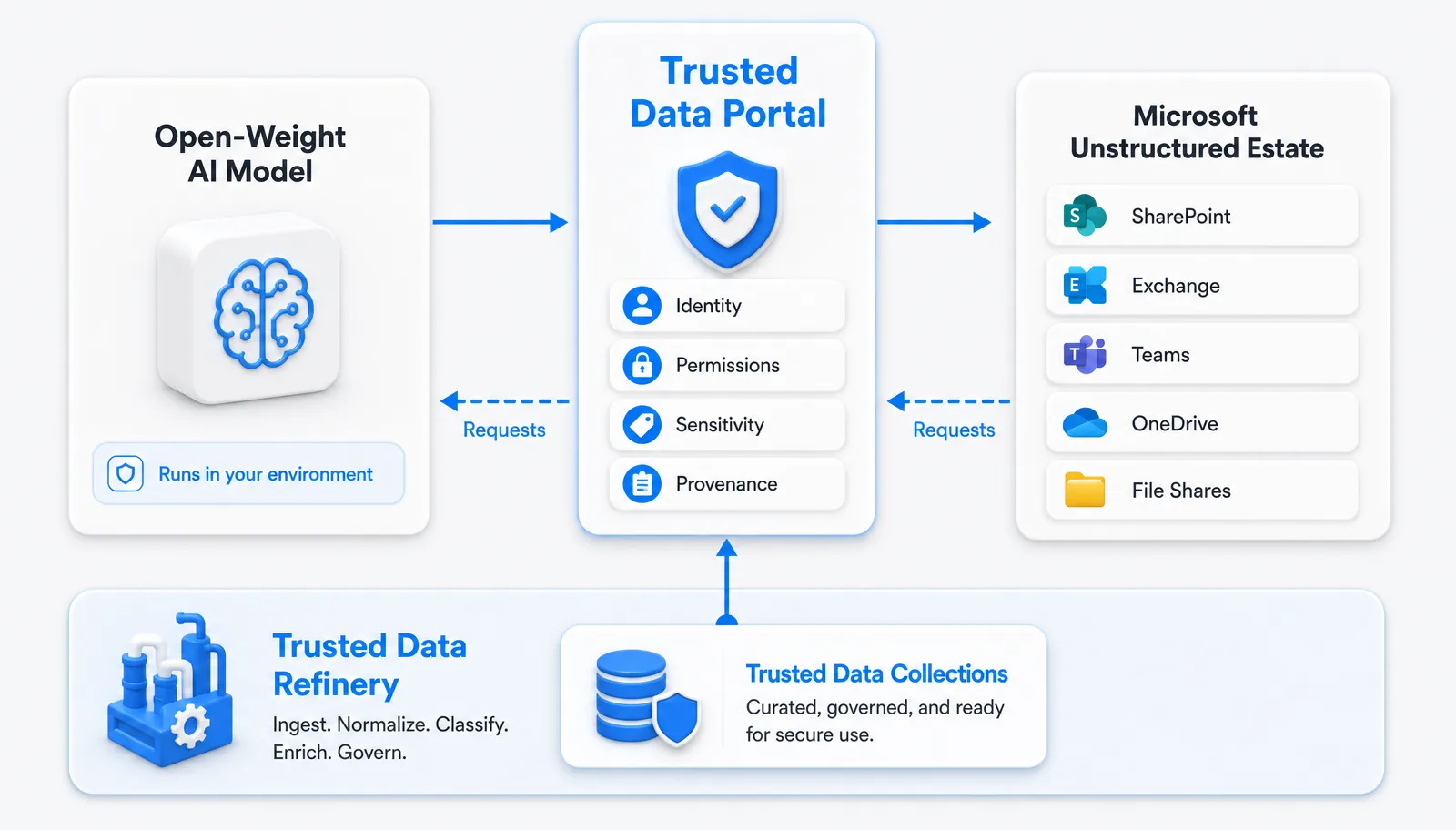
Smart Stack 3.0 supplies the missing half. The Trusted Data Refinery makes the estate understood and governed. The Trusted Data Portal decides what the model may reach. The model supplies intelligence. Smart Stack 3.0 supplies trust.
How An Open-Weight Model Works With Smart Stack 3.0
Six steps, in order. The model supplies intelligence. Smart Stack 3.0 supplies trust.
1
Trusted Data Refinery
Smart Stack Finds And Understands The Data
The Trusted Data Refinery scans the unstructured estate, identifies what is valuable, and detects duplicates, obsolete files, sensitive information, and compliance risk.
The enterprise sees its estate before any model touches it.
The Governed Boundary
Select the Trusted Data Portal to see what it enforces between the model and the estate.
Open-Weight Model
Selected by the customer, operated inside the customer environment.
Enterprise Estate
SharePoint, Exchange, Teams, OneDrive, and File Shares, refined into Trusted Data Collections.
Is Open-Weight AI Right For Your Environment
Select every statement that is true of your organization today.
Result
Hosted Services Are Likely Sufficient For Now
Open-weight operation may not yet be warranted. The data work still is. Refining and governing the unstructured estate improves hosted AI outcomes today and preserves the option to bring intelligence in-house later.
What Changes For Each Leader
The same capability matters differently across the leadership table.
One trusted data foundation that serves whichever models the organization adopts next, without another program of work each time.
The Questions Enterprises Ask First
It can, because the model runs where the enterprise chooses. Sovereignty still depends on where the data itself resides and how access is governed, which is what the Trusted Data Portal enforces.
Keep Reading
Bring Your Own Model. Keep Your Own Rules.
We will map your estate, your governance requirements, and the models you are evaluating.