Problems Solved
Customer-Operated AI Without Governed Access
Open-weight models give the enterprise control of the intelligence. Without a governed data boundary, that control ends at the model and stops short of the estate it reads.
Customer-Operated AI Without Governed Access
Owning the AI is not the same as controlling what it can see. Smart Stack 3.0 supplies the trusted data foundation and the governed access boundary that customer-operated models depend on.
The Problem
Enterprises adopting open-weight AI gain control of the intelligence and inherit a harder problem. The model now runs inside the organization, close to everything the organization has ever stored. SharePoint sites, Exchange content, Teams history, OneDrive folders, and decades of File Shares hold duplicated drafts, obsolete records, privileged material, and regulated personal information that was never classified.
A model with broad access to that estate is not an advantage. It is exposure. It will answer questions using content the requester was never entitled to see, cite superseded versions as current fact, and process volumes of worthless content at real infrastructure cost.
Why It Persists
Model selection is a procurement and engineering decision that can be made in weeks. Making an unstructured estate understood, classified, and access-governed is organizational work that most enterprises have deferred for years. The two timelines do not match, so the model arrives first and is pointed at whatever is reachable.
Native platform controls assume content is already labeled and permissions are already correct. Across an estate built over decades, neither assumption holds.
The Zantaz Solution
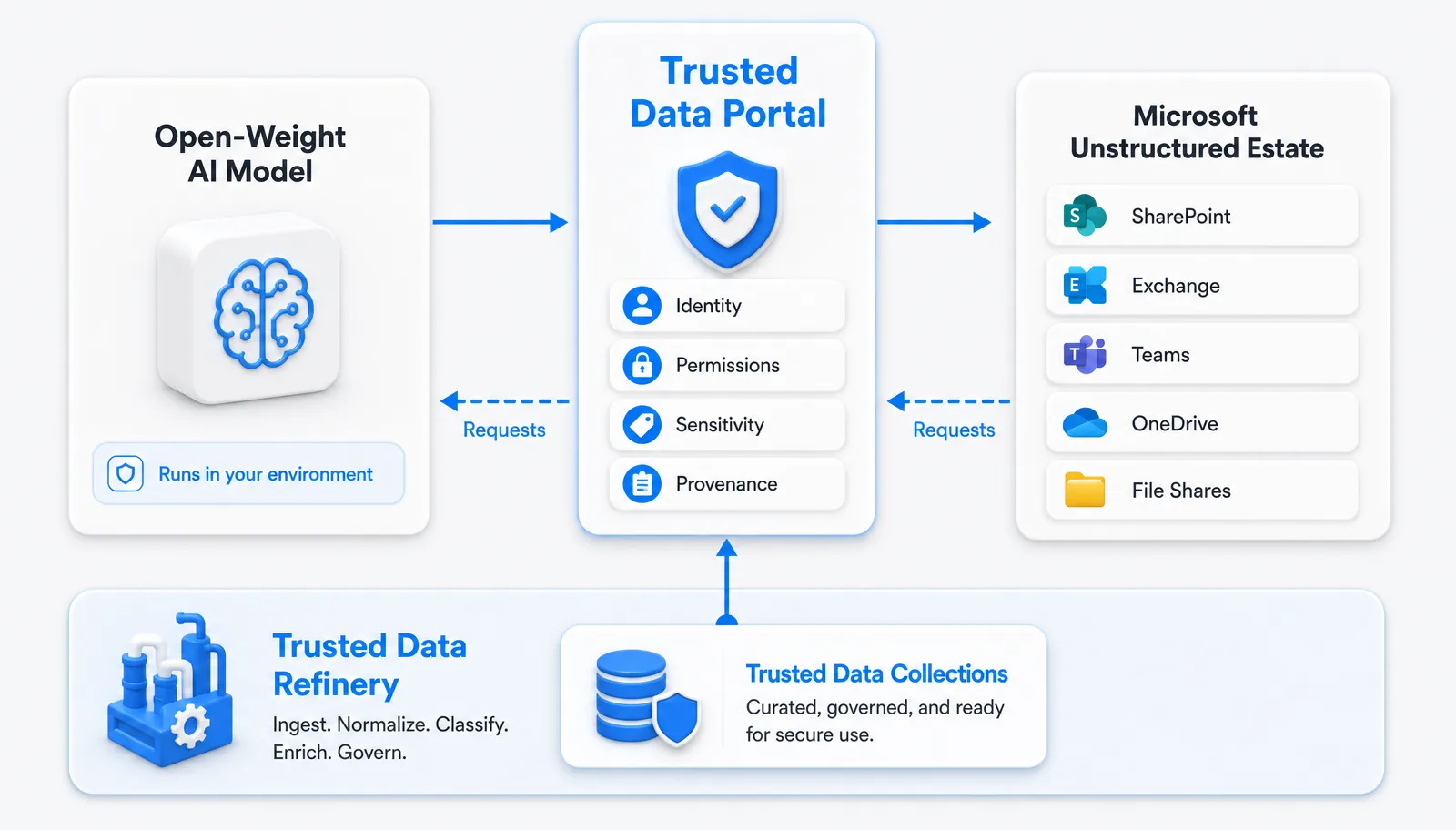
Smart Stack 3.0 separates intelligence from access. The Trusted Data Refinery scans the unstructured estate in place, identifies value, duplication, sensitivity, ownership, and retention obligation, then organizes what matters into Trusted Data Collections.
The Trusted Data Portal then becomes the single governed boundary between any model and that estate. It enforces identity, permissions, sensitivity, and retention state on every request, and returns provenance with every answer. The customer keeps the freedom to change models, because the model was never the foundation.
What Changes
Retrieval is limited to approved, context-rich content rather than everything reachable. Regulated material stays behind policy. Redundant, obsolete, and trivial content is removed from the processing path, which lowers infrastructure cost and improves answer quality at the same time. Every response can be traced to a source, version, and policy context.
Conclusion
Open-weight AI answers the question of who owns the intelligence. Smart Stack 3.0 answers the question that decides whether it is safe to use.
60%
Of Enterprise Storage Is Redundant, Obsolete, Or Trivial
25%
Of A Typical CIO Budget Consumed By Compute
1
Governed Boundary Between Any Model And The Estate
The Governed Boundary
Select the Trusted Data Portal to see what it enforces between the model and the estate.
Open-Weight Model
Selected by the customer, operated inside the customer environment.
Enterprise Estate
SharePoint, Exchange, Teams, OneDrive, and File Shares, refined into Trusted Data Collections.