
Smart Stack 3.0
BFSI Data HUB
The trusted data infrastructure financial institutions cannot operate without.
Compliance-Grade Data Governance for Every Regulator, Every Audit, Every AI Initiative
Financial services organizations operate under some of the most stringent data governance requirements in any industry. SEC and FINRA retention mandates require that every electronic communication is captured, preserved, and producible on demand. DORA demands operational resilience across the full data infrastructure. And the growing pressure to deploy AI across trading, compliance, and risk functions runs directly into a problem most institutions have not solved: the Microsoft data environments where the majority of communications and unstructured operational data live have never been systematically governed.
BFSI Data HUB applies Smart Stack 3.0 to the specific Microsoft environments that create regulatory exposure and constrain AI adoption in financial services: Exchange and M365 communications, on-premise Windows File Shares, and SharePoint. Not your trading platforms. Not your core banking systems. The ungoverned communications and file estate that sits beneath them.
The Challenge
Exchange and M365 communications are the primary record of trader conversations, advisory correspondence, deal discussions, and compliance communications. FINRA Rule 4370 and SEC Rule 17a-4 require that these records be captured completely, preserved immutably, and producible within regulatory timeframes. Incomplete journaling, missing envelope data, and gaps in BCC capture create regulatory exposure that most firms do not discover until an examination is already underway. Microsoft 365 is not a compliant archive. It is a collaboration platform with retention features that do not meet the evidentiary and immutability standards regulators require.
SharePoint environments in financial services have expanded rapidly with M365 adoption. The result is sprawl: team sites with no data owners, document libraries with no retention policy, and sensitive client data, deal documentation, and compliance records in environments that have never been classified or governed. When a regulatory examination requests documentation, the inability to scope and produce from SharePoint cleanly is both a compliance failure and an operational crisis.
On-premise Windows File Shares in financial services frequently contain years of operational records: trade files, client correspondence, audit documentation, and internal communications. These environments are often the least visible and least governed in the estate. They represent unquantified regulatory exposure and significant AI readiness gaps, because ungoverned file share data cannot be safely or reliably used to power AI applications.
AI adoption in financial services is accelerating. Copilot for M365, Fabric-powered risk analytics, and AI-driven compliance monitoring all depend on data quality. When that data has never been governed for provenance, accuracy, or admissibility, the AI outputs carry the same governance failures as the data consumed.
The Unstructured File Estate Problem
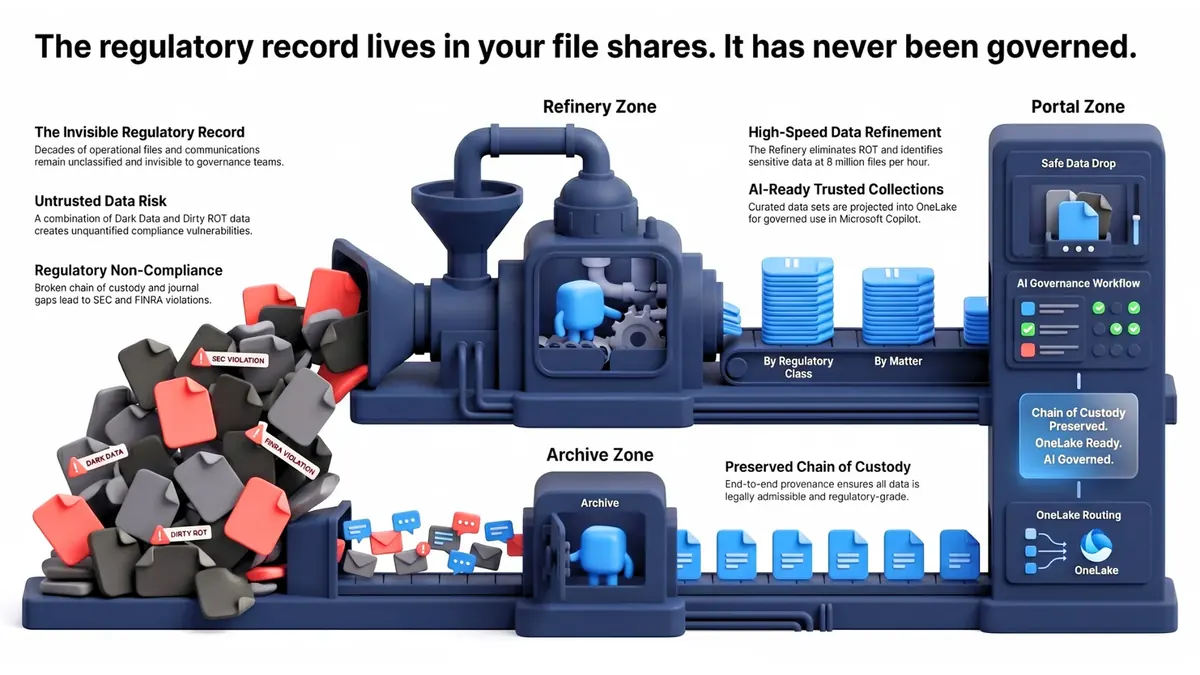
The regulatory record lives in your file shares. It has never been governed.

Financial services organizations govern their structured systems with extraordinary rigor. Trading platforms, portfolio management systems, core banking applications, all of it is tightly controlled, regularly audited, and well documented. The unstructured file estate that surrounds those systems has received almost none of that attention. And it is in the unstructured file estate that the regulatory record actually lives.
A regional bank or asset manager has file shares containing the operational record of every deal, every client relationship, and every compliance decision the organization has made. Trade support documentation. Client onboarding files. Internal audit findings. Regulatory correspondence. All of it saved by analysts and associates who organized it the way it made sense to them at the time, without thought for how it would need to be searched during an SEC examination five years later.
SharePoint has grown with M365 adoption and the sprawl follows the same pattern: team sites for every product group, every client team, every compliance function. Document libraries that reflect organizational structures from two reorganizations ago. Content owned by employees who left years ago. In a regulated financial services environment, every one of these sites is a potential source of responsive records during an examination, and a potential source of surprise.
PII is embedded throughout the estate in forms that were never intended to be there: client financial statements saved to shared drives during onboarding, account applications with Social Security numbers saved as email attachments, trade confirmations downloaded and stored in folder structures the compliance team cannot fully map. None of it is visible without classification.
The Trusted Data Refinery scans Windows File Shares and SharePoint, applies Sensitive Data Classification, eliminates ROT, and produces Trusted Data Collections aligned to regulatory scope. Unified Optic gives compliance leadership the first complete picture of where the regulatory record actually lives, by environment, by business unit, by age.
"It is in the unstructured file estate that the regulatory record actually lives."
BFSI Data HUB Trusted Data Toolkit
Trusted Data Archive
Communications Governance
Compliance-grade journal archiving from Exchange and Microsoft 365 captures every electronic communication in real time with complete envelope preservation: BCC recipients, expanded distribution lists, original routing metadata, and timestamps. WORM-compliant, tamper-proof, immutable storage with a tamper-evident audit trail for every access and export event. The foundation for SEC Rule 17a-4, FINRA retention, and MiFID II electronic communications compliance. For Azure-aligned institutions, Arcivium for Azure delivers the same compliance outcome within the client's Azure tenancy.
Trusted Data Refinery
Operational Data Intelligence
The Trusted Data Refinery scans Windows File Shares and SharePoint in place, without moving data until it is classified and trusted. At 8 million file objects per hour, it builds a complete estate inventory. PII detection runs through Microsoft Presidio and pattern matching, identifying account numbers and sensitive financial data embedded in unstructured files. ROT data is flagged and eliminated. Trusted Data Collections scoped to regulatory obligation or business unit: clean, classified, provenance-aware output sets ready for regulatory production or AI consumption. Unified Optic provides estate-wide intelligence with geolocation overlay.
Trusted Data Portal
Governed Intake and AI Activation
Governed intake for regulatory submissions and internal compliance workflows. The AI Governance Workflow is the control layer for Copilot and Fabric adoption: before any data set reaches an AI application, it is validated for policy alignment, provenance, and sensitivity classification. Only Trusted Data Collections clear for consumption. Trusted Data Collections route to OneLake for Microsoft Fabric analytics and Purview integration. Chain of custody and provenance metadata travel with every data set through the entire pipeline.
BFSI Data HUB Briefing
Launch the interactive Smart Stack 3.0 executive briefing tailored for your industry.
BFSI Data HUB
Powered by Smart Stack 3.0