
Smart Stack 3.0
Data Ready HUB
The enterprise data readiness platform. Built for the CDO who needs to move fast and govern everything.
The Enterprise Data Readiness Foundation for Every AI and Compliance Initiative
Chief Data Officers are under more simultaneous pressure than at any point in the history of the role. The board wants AI transformation delivered at pace. Legal and compliance want demonstrable data governance maturity. Regulators want evidence that the organization knows where its data is, what it contains, and who has accessed it. And the infrastructure teams want a clear path to OneLake, Fabric, and Copilot adoption that does not create new risk.
Every one of these pressures runs into the same foundational problem: the Microsoft data environments where the majority of the enterprise's communications and unstructured knowledge live have never been systematically governed. Exchange and M365 communications are archived incompletely or not at all. Windows File Shares have grown for years without classification, ownership mapping, or retention policy enforcement. SharePoint has sprawled across the organization with no governance layer. And the AI initiatives that depend on this data inherit every governance failure in the foundation.
Data Ready HUB is the executive-level framework for deploying Smart Stack 3.0 as the enterprise data readiness infrastructure. Not a point solution for one use case. A governed foundation for every downstream AI, analytics, and compliance initiative the organization needs to run.
The Challenge
On-premise Windows File Shares are frequently the largest and least governed data environment in the enterprise estate. Decades of unstructured operational data, departmental files, correspondence, and records have accumulated with no classification layer, no ROT elimination, and no visibility into what is actually stored. The organization does not know what it has. It cannot demonstrate to regulators what controls apply to it. And it cannot safely use it to power AI applications because the provenance and quality of the data have never been established.
SharePoint Online has sprawled with M365 adoption. Sites created for projects that concluded years ago remain active. Document libraries have no data owners. Retention policies are inconsistently applied. Sensitive content sits alongside general operational content with no classification to distinguish them. The governance deficit in SharePoint is not a future risk. It is a present condition in most large organizations.
Exchange and M365 communications are the primary knowledge record of the enterprise: decisions made, strategies discussed, regulatory commitments given, supplier terms agreed. Without compliance-grade journal archiving, this record is incomplete, vulnerable to deletion, and missing the envelope data that makes communications admissible. When the board asks whether the organization's AI transformation is built on trusted data, the communications foundation is frequently the weakest link.
Microsoft Teams has accelerated the communications governance gap. The volume of Teams messages, shared files, and persistent chat records that must be governed under the same standards as email has grown dramatically, and most archiving programs have not kept pace.
The AI readiness imperative compounds all of this. Copilot for M365 consumes data from Exchange, SharePoint, and OneDrive. Fabric-powered analytics pipelines ingest from file shares and SharePoint. If the underlying data has never been classified, governed for retention, or enriched with provenance metadata, AI outputs reflect the chaos of the underlying estate. The CDO cannot deliver AI transformation on an ungoverned data foundation.
The Unstructured File Estate Problem
Most enterprises are running AI on a data estate that has never been systematically governed. That is the gap Smart Stack 3.0 closes.
The Chief Data Officer's mandate is to make the organization's data an asset, governed, trusted, and ready for the AI and analytics applications that generate competitive advantage. The obstacle is not the AI platform. It is not the analytics infrastructure. It is not the talent. The obstacle is the file estate that every employee has been creating content in for decades, without governance, without classification, and without anyone taking stock of what actually exists.
For a 10,000-person organization, the file estate contains somewhere between 100 million and 1 billion file objects across Windows File Shares, SharePoint, and OneDrive. Between 50 and 70 percent is ROT. Of the remainder, a significant portion contains sensitive data that was never intended to be stored in general-purpose file shares. The rest is genuine operational content, contracts, policies, correspondence, work product, that has never been classified, never had metadata enriched, and never had provenance established.
The CDO faces a convergence of pressures that all trace back to the same unclassified file estate. The board wants AI transformation, but AI built on ungoverned data produces unreliable outputs that create liability rather than value. Legal and compliance want demonstrable governance maturity, but the organization cannot demonstrate what it has never measured. Regulators want evidence that the organization knows where its data lives, but the file estate has never been inventoried. The budget committee wants storage cost optimization, but ROT that has never been identified cannot be eliminated.
Copilot for M365 consumes content from Exchange, SharePoint, and OneDrive. Fabric analytics pipelines ingest from file shares and SharePoint. Custom AI applications reason over whatever content they can access. When the underlying file estate has never been classified, every AI initiative inherits the full chaos of that estate. The CDO who deploys AI on an ungoverned data estate is accelerating the organization's exposure, not its capabilities.
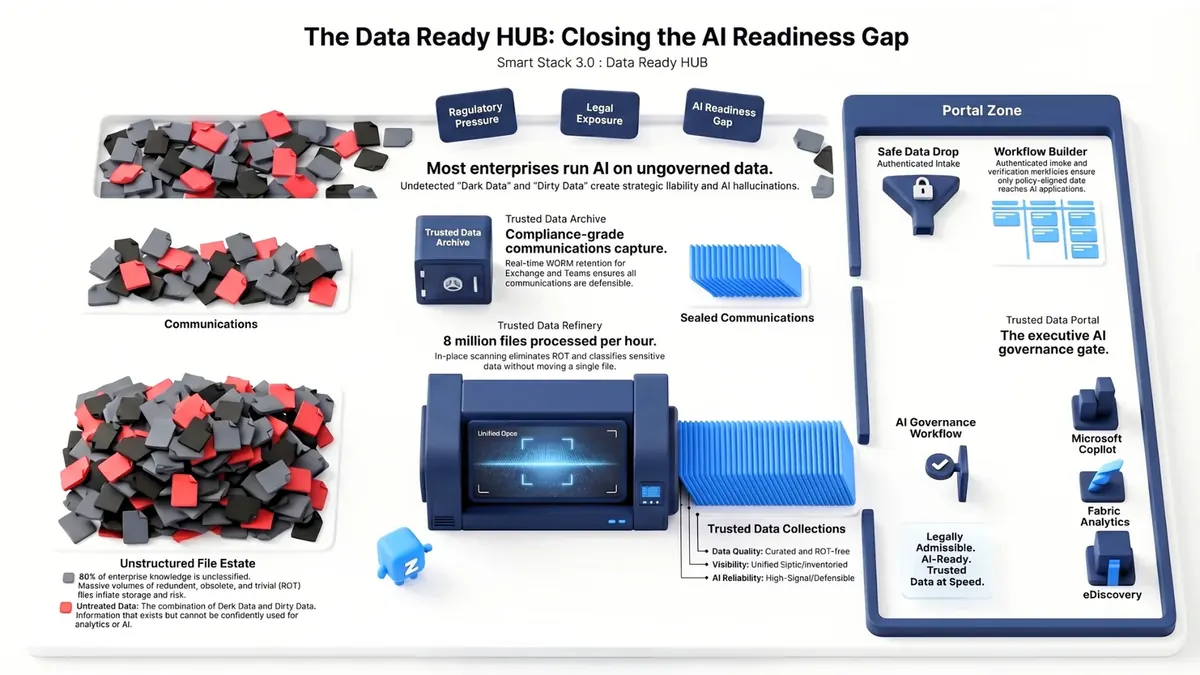
The Trusted Data Refinery is the enterprise data readiness program at scale. Unified Optic delivers the estate intelligence dashboard the CDO needs: the first complete picture of what exists, where it lives, how old it is, what percentage is ROT, and where sensitive data concentrations are. ROT is eliminated. Sensitive data is governed. Trusted Data Collections are produced by business unit, regulatory obligation, and AI application domain, ready for Copilot, Fabric, Snowflake, and any downstream system that requires trusted data to produce trusted outputs.
"The gap is not in the AI platform. The gap is in the data estate that feeds it."
Data Ready HUB Trusted Data Toolkit
Trusted Data Archive
Communications Governance
The Trusted Data Archive is the communications foundation for the entire enterprise data readiness program. Compliance-grade journal archiving from Exchange, M365, and Teams captures every communication in real time with complete envelope preservation: BCC recipients, expanded distribution lists, original timestamps, and routing metadata. WORM-compliant, tamper-proof storage and a tamper-evident audit trail for every access and export event. When the communications record is complete, defensible, and provenance-verified from day one, every downstream use case, from eDiscovery to Copilot, is built on ground that can be trusted.
Trusted Data Refinery
Operational Data Intelligence
The Trusted Data Refinery is the operational intelligence layer for the entire enterprise file estate. At 8 million file objects per hour, it scans Windows File Shares and SharePoint in place, building a complete estate inventory across every department, region, and business unit. Unified Optic delivers the visibility the CDO has been asking for: file extension distribution, data age timelines, ROT percentages, PII concentration maps, and a geolocation overlay showing exactly where data concentrations exist across the organization. ROT elimination, PII detection via Microsoft Presidio, metadata enrichment, and the curation of Trusted Data Collections by business unit, regulatory obligation, or AI application domain: this is the data readiness program at enterprise scale.
Trusted Data Portal
Governed Intake and AI Activation
The Trusted Data Portal is the executive control layer for the entire data readiness program. Safe Data Drop provides governed intake for regulatory inquiries, legal matters, and internal compliance workflows across the organization. Workflow Builder orchestrates enterprise-wide processes: legal hold, regulatory response, and AI governance workflows applied consistently across every business unit. AI Governance Workflow is the Copilot and Fabric control layer: before any data set reaches an AI application, it is validated for policy alignment, provenance, and sensitivity classification. Only Trusted Data Collections that meet the organization's AI governance standards pass through to consumption. Trusted Data Collections route to OneLake for Fabric-powered analytics across the organization. Chain of custody and provenance metadata travel with every data set from the file share or email archive where it originated to the AI application or analytics dashboard where it creates value.
Data Ready HUB Briefing
Launch the interactive Smart Stack 3.0 executive briefing tailored for your industry.
Data Ready HUB
Powered by Smart Stack 3.0