
Smart Stack 3.0
Fed HUB
Coming SoonSovereign. Defensible. Mission-ready. The trusted data layer for federal environments.
Sovereign Data Governance for the Federal Microsoft Environment
Federal agencies operate under the most demanding data governance requirements in any sector. FISMA, FedRAMP, and NARA records management standards are not optional frameworks. They are legal obligations. And the accelerating mandate to deploy AI responsibly across agency functions runs directly into a problem most agencies have not fully solved: the Microsoft data environments where the majority of agency communications and unstructured operational data live have never been systematically governed to the standard those mandates require.
Fed HUB will bring Smart Stack 3.0 to federal deployments, purpose-built for sovereign, air-gappable, and compliance-grade operation within Microsoft GCC and GCC High environments. The scope is the Microsoft data layer that creates governance gaps in every large organization: on-premise Windows File Shares, SharePoint, and Exchange and M365 communications. Not your ERP. Not your case management system. The ungoverned unstructured data layer that sits beneath mission-critical operations and has not yet been governed to federal standard.
The Challenge
Exchange and M365 communications in federal environments must meet NARA records management standards and agency-specific records schedules. Journal archiving gaps, missing envelope data, and incomplete retention policy implementation create compliance exposure that may only surface during an Inspector General review or a Congressional inquiry. Microsoft 365 is not a NARA-compliant system of record. It is a collaboration platform. The archiving and defensibility layer must be added separately.
On-premise Windows File Shares in federal agencies frequently contain years of operational records: program documentation, correspondence, administrative records, and agency-specific operational files subject to NARA disposition schedules and FOIA producibility requirements. These environments are often among the largest and least governed in the agency estate. When a FOIA request requires production from these environments, the inability to scope, classify, and produce cleanly creates both compliance exposure and operational burden.
SharePoint environments have expanded across agencies with M365 adoption, creating the same sprawl pattern seen in large enterprises: sites without data owners, libraries without retention policies, and sensitive agency content distributed across hundreds of team sites with no governance layer. FISMA controls require that the agency knows where its data lives and can demonstrate appropriate access controls. SharePoint sprawl makes that demonstration difficult.
AI adoption across federal agencies is accelerating, driven by executive mandates and mission requirements. AI applications that consume agency data must be able to demonstrate data provenance, appropriate access controls, and alignment with agency data governance policies. When the underlying data has never been classified or governed at the file and communications level, AI deployment creates new risk rather than new mission capability.
The Unstructured File Estate Problem
Mission-ready AI requires mission-grade data governance. The gap is in the file estate.
Federal agencies operate under the most demanding data governance requirements in any sector. FISMA, FedRAMP, NARA records management standards, and agency-specific records schedules create a compliance framework that is both comprehensive and mandatory. The problem is that the unstructured file estate, the Windows File Shares and SharePoint environments where the operational record of the agency actually lives, has never been governed to the standard those requirements demand.
A federal agency has file servers reflecting decades of operational history. Program documentation from initiatives that concluded years ago. Administrative records from organizational structures that have since been reorganized. Files created under records schedules that have since been updated, sitting in the estate with the wrong disposition applied or no disposition applied at all. NARA requires that federal records be managed according to approved records schedules from the moment of creation. The operational reality is that the vast majority of content in agency file shares has never had a records schedule applied.
SharePoint sprawl in federal environments creates simultaneous FOIA compliance risk and FISMA risk. The agency cannot demonstrate appropriate access controls over content it has never inventoried, and it cannot respond to FOIA requests from content it cannot search with confidence. An agency with 800 SharePoint team sites, most of which have never been inventoried, cannot make that FOIA search confidently within statutory timeframes.
Federal AI initiatives require data that is provenance-aware, access-controlled, and classified. AI tools deployed in federal environments that consume file estate content without governance may surface records the requesting user should not see or reason over records subject to exemption. The defensibility of AI outputs in federal decision-making contexts depends entirely on the governance of the underlying data.
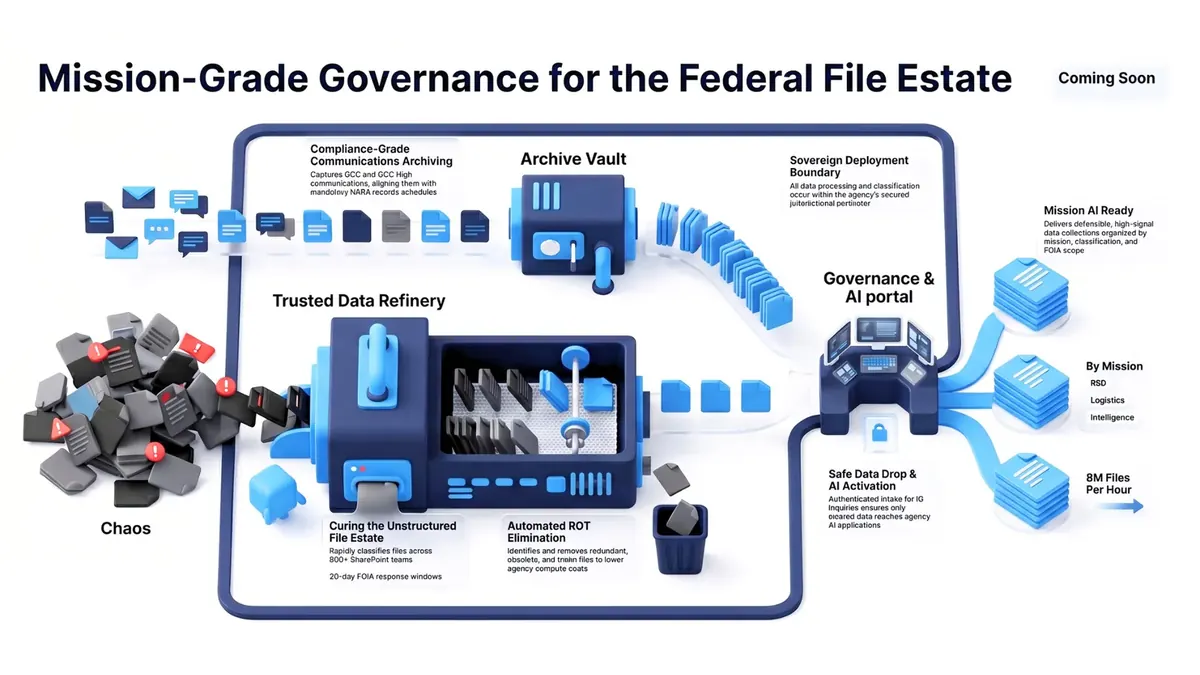
The Trusted Data Refinery deploys within the sovereign boundary of the agency environment, on-premises or within GCC or GCC High, scanning without data leaving the perimeter. NARA records schedules are applied to Trusted Data Collections as part of the classification process. FISMA-aligned governance controls are applied to every classified data set.
"The defensibility of AI outputs in federal decision-making contexts depends entirely on the governance of the underlying data."
Fed HUB Trusted Data Toolkit
Trusted Data Archive
Communications Governance
The Trusted Data Archive will deliver compliance-grade journal archiving for Exchange and M365 within GCC and GCC High environments, capturing every agency communication in real time with complete envelope preservation, WORM-compliant immutable storage, and tamper-evident audit trails aligned to NARA records schedules and agency disposition requirements. Every communication captured, preserved, and producible in the timeframes and formats federal compliance requires.
Trusted Data Refinery
Operational Data Intelligence
The Trusted Data Refinery will scan Windows File Shares and SharePoint in place within the agency boundary, without data leaving the sovereign deployment perimeter. PII and sensitive data detection, ROT elimination, and metadata enrichment produce Trusted Data Collections aligned to FISMA controls and agency mission scope. For the first time, the agency has complete visibility into its unstructured data estate and a governed, classified foundation for AI adoption.
Trusted Data Portal
Governed Intake and AI Activation
The Trusted Data Portal will provide governed intake for FOIA requests, Inspector General inquiries, and inter-agency data sharing, with data sovereignty controls configurable by classification boundary and jurisdiction. AI Governance Workflow ensures only policy-aligned, provenance-verified data reaches agency AI applications. Copilot and Fabric integration delivered through a defensible trust layer that federal compliance requirements demand.
Fed HUB Briefing
Launch the interactive Smart Stack 3.0 executive briefing tailored for your industry.
Fed HUB
Powered by Smart Stack 3.0