
Smart Stack 3.0
Industrial Data HUB
The intelligence layer for the modern industrial enterprise.
Governing the Unstructured Data Behind Every Safety Record and Engineering File
Manufacturing organizations are managing a data transformation challenge that is more complex than most recognize. Decades of engineering documentation, safety records, environmental compliance files, quality assurance records, and supplier communications have accumulated in Microsoft environments, primarily Windows File Shares and SharePoint, that were never designed for governance, defensibility, or AI readiness. These are not the structured systems IT controls tightly. They are the file estates that grew organically alongside production operations, and they represent both significant regulatory exposure and significant untapped operational intelligence.
Industrial Data HUB applies Smart Stack 3.0 to the Microsoft data environments where manufacturing risk and manufacturing intelligence live: on-premise Windows File Shares, SharePoint, and Exchange and M365 communications. Not your MES. Not your ERP. The ungoverned unstructured data layer that sits alongside your production systems and has never been systematically governed.
The Challenge
On-premise Windows File Shares in manufacturing organizations are frequently the largest and oldest data environments in the estate. Engineering drawings, safety data sheets, incident investigation records, environmental compliance filings, quality audit documentation, and supplier correspondence have accumulated over years and often decades, with no classification layer, no ownership mapping, and no retention policy enforcement. When a product liability matter is initiated, or an environmental regulator requests documentation of safety practices over a specific period, the inability to scope and produce from these environments cleanly is both a legal liability and an operational crisis.
SharePoint environments in manufacturing have expanded with M365 adoption, creating sites for engineering teams, quality functions, environmental compliance, and supplier management. Without governance, these environments mirror the file share problem at scale. Safety records sit next to general project files. Compliance documentation is distributed across dozens of sites with no central classification.
Exchange and M365 communications carry the record of supplier negotiations, safety incident communications, regulatory correspondence, and internal quality discussions. Without compliance-grade journal archiving, these communications are vulnerable to deletion and alteration. In product liability litigation, the communications record is frequently as material as the engineering documentation.
The AI opportunity in manufacturing is real and urgent: predictive maintenance, quality control analytics, and supply chain risk intelligence all depend on operational data quality. When the underlying file share and SharePoint data has never been classified or enriched, AI outputs are unreliable and the organization cannot act on them with confidence.
The Unstructured File Estate Problem
Decades of safety and engineering data. No classification layer. No governance.

Manufacturing organizations have some of the oldest and deepest file estates in enterprise computing. Engineering documentation, safety records, environmental compliance filings, and supplier correspondence have been accumulating in file shares since the earliest days of networked computing in industrial environments. Some of it is decades old. None of it has ever been systematically inventoried. And all of it is potentially material in the product liability, environmental, and regulatory contexts that manufacturing organizations face.
A manufacturing organization with multiple facilities has file servers that have been running continuously for fifteen or twenty years in some locations. Engineering file shares contain drawing revisions going back to product generations that are no longer manufactured. Safety data sheets for chemicals that have since been reformulated. Incident investigation records from events resolved years ago. Environmental compliance filings from regulatory regimes that have since been updated. None of these files were created without purpose. The problem is that they were created without governance and have accumulated without anyone taking stock.
A product liability claim requiring ten years of safety incident correspondence and engineering file history is a genuine operational and legal crisis for an organization whose file estate has never been inventoried. The inability to produce those records on demand, or the accidental production of records that create additional exposure, is directly traceable to the absence of governance. Environmental compliance adds a second major risk: manufacturing organizations are subject to complex multi-jurisdictional environmental regulations, and the documentation of compliance with those regulations lives in file shares that may be inaccessible or contaminated with superseded records.
AI-powered predictive maintenance, quality control analytics, and supply chain risk intelligence require operational data of high quality. When these tools consume file estate content that includes outdated maintenance records alongside current ones and superseded quality specifications alongside active ones, the predictive outputs are unreliable.
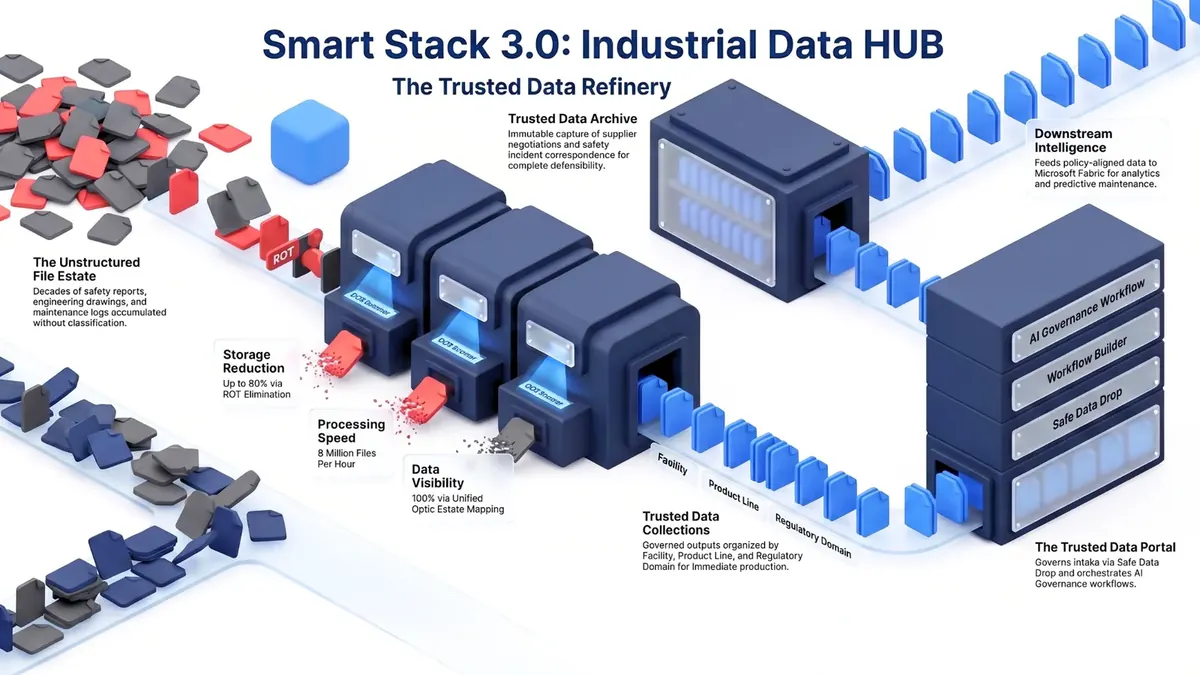
The Trusted Data Refinery connects to Windows File Shares and SharePoint across all manufacturing facilities, applying OCR to engineering drawings and technical documentation to make even image-based content searchable and classifiable. Trusted Data Collections organized by facility, product line, and regulatory domain give legal and compliance teams organized, defensible document sets for the first time.
"None of these files were created without purpose. The problem is that they were created without governance and have accumulated without anyone taking stock."
Industrial Data HUB Trusted Data Toolkit
Trusted Data Archive
Communications Governance
The Trusted Data Archive captures all Exchange and M365 communications in real time: supplier negotiations, safety incident correspondence, regulatory submissions, and internal quality communications, all preserved with complete envelope data, WORM-compliant storage, and a tamper-evident audit trail. In product liability litigation, the complete communications record between engineering teams, quality functions, and suppliers over a specific period is frequently decisive. The Archive makes that record complete, defensible, and immediately producible.
Trusted Data Refinery
Operational Data Intelligence
The Trusted Data Refinery scans Windows File Shares and SharePoint in place at petabyte scale: engineering documentation, safety records, environmental compliance files, quality audit records, and supplier correspondence, all classified, enriched with metadata, and curated into Trusted Data Collections scoped by facility, product line, or regulatory domain. The Analysis Engine applies OCR to image files and engineering drawings, making content searchable and classifiable at scale. Trusted Data Collections delivered to OneLake make governed manufacturing data available for Fabric-powered predictive maintenance, quality analytics, and supply chain risk intelligence.
Trusted Data Portal
Governed Intake and AI Activation
Safe Data Drop provides authenticated, encrypted intake for regulatory agencies, insurers, and internal compliance leadership. Workflow Builder orchestrates regulatory response workflows: when an environmental agency or product safety regulator issues a request, the matter is logged, the relevant data sources are scoped, and Trusted Data Collections are assembled for production. AI Governance Workflow controls which operational data sets reach Copilot and Fabric applications, ensuring AI outputs in the manufacturing environment are built on a trusted data foundation.
Industrial Data HUB Briefing
Launch the interactive Smart Stack 3.0 executive briefing tailored for your industry.
Industrial Data HUB
Powered by Smart Stack 3.0