
Smart Stack 3.0
Legal HUB
Where defensible data meets the demands of discovery.
Defensible Data for Every Matter, Every Custodian, Every Deadline
When litigation hits or a regulatory inquiry lands, the first question is always the same: where is the data, and can you trust it? For most legal teams and in-house counsel, the honest answer is complicated. Communications from Exchange and M365 are often incomplete, improperly journaled, or missing the envelope data that makes them admissible. SharePoint environments have grown for years without governance, filled with redundant, outdated, and trivial content sitting alongside genuinely material documents. On-premise Windows File Shares contain decades of unstructured matter files, contracts, and correspondence with no classification layer, no ownership mapping, and no chain of custody. The data exists. Whether it is defensible is a different question entirely.
Legal HUB applies Smart Stack 3.0 specifically to the Microsoft data environments where legal risk lives: your communications infrastructure and your unstructured file estate. Not your ERP. Not your document management system. The ungoverned layer underneath everything else.
The Challenge
The specific Microsoft environments that create legal exposure are the ones most organizations have never systematically governed.
Exchange and M365 email is the primary communications record in every enterprise. But journal archiving is frequently misconfigured, incomplete, or missing BCC recipients and expanded distribution list data. When outside counsel asks for a complete communications record for a custodian, gaps in journaling become gaps in production. Microsoft 365 does not solve this. It was designed for collaboration, not evidentiary preservation.
SharePoint environments in large organizations have grown organically for a decade or more. The result is sprawl: sites no longer owned by active employees, document libraries with no retention policy, duplicated content across dozens of team sites, and sensitive matter documents sitting next to general corporate content with no access control review. In discovery, this sprawl means cost. Every redundant, obsolete, or trivial document that reaches review is billable time wasted.
On-premise Windows File Shares are frequently the oldest and least governed data environment in the enterprise. Matter files, contracts, correspondence, and historical records accumulated over years with no classification, no ROT elimination, and no visibility into what is actually stored where. When a litigation hold is triggered, these environments are the hardest to scope and the most expensive to process.
The result: eDiscovery costs spiral before review even begins. Legal holds are over-inclusive because the data estate is not understood. Chain of custody cannot be demonstrated for documents that have never been governed. And AI-powered legal tools produce unreliable outputs because the data they consume has never been trusted.
The Unstructured File Estate Problem
Your file estate has never been classified. eDiscovery starts there.

When we talk to legal teams and in-house counsel, the conversation about data always starts with the same place: the matter management system, the document management system, the archive. Those systems are well governed. The problem is that they only contain what was deliberately filed into them. Everything else, every working file, every email attachment that was saved locally, every draft that accumulated over the course of a negotiation, every SharePoint site that was created for a matter and never cleaned up, lives in the unstructured file estate. And the unstructured file estate has never been governed.
In a law firm or legal department running on Microsoft, the file estate is where the real discovery risk lives. Windows File Shares contain matter files going back years, organized the way individual attorneys and paralegals organized them at the time, with no consistent naming convention, no retention schedule, and no classification layer. SharePoint contains team sites for practice groups, client teams, and projects, some active, many abandoned, with document libraries that reflect organizational structures that no longer exist. OneDrive contains personal working copies of documents that were never moved to a shared location.
When eDiscovery hits, the question is not whether the files exist. They almost certainly do. The question is where they are, how many are responsive, and how many are duplicates that inflate the review population without adding information. Without ROT elimination and classification upstream, every redundant version of every negotiated document reaches review. Every near-duplicate correspondence thread is reviewed in full. The ROT tax in legal eDiscovery is measured in attorney hours and review platform costs, and it is entirely avoidable.
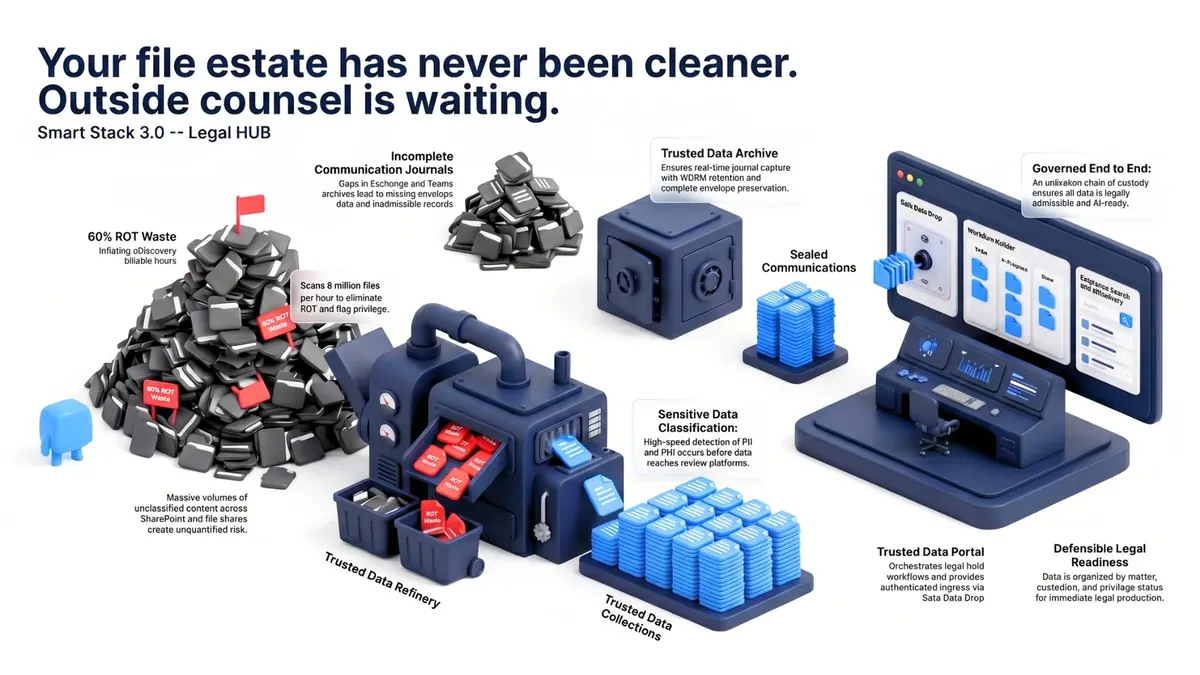
The Trusted Data Refinery connects to the legal organization's Windows File Shares and SharePoint, scans in place at 8 million file objects per hour, and produces Trusted Data Collections organized by matter, custodian, and privilege status with attorney-client flagging built in. By the time documents reach billable review, they have already been governed.
"The ROT tax in legal eDiscovery is measured in attorney hours and review platform costs, and it is entirely avoidable."
Legal HUB Trusted Data Toolkit
Trusted Data Archive
Communications Governance
The Trusted Data Archive solves the communications capture problem at its root. It performs compliance-grade journal archiving directly from Exchange and Microsoft 365, capturing every communication in real time before it can be altered, deleted, or stripped of envelope data. Every email is preserved with its complete envelope: BCC recipients, expanded distribution lists, routing metadata, and original timestamps. WORM-compliant, tamper-proof, immutable storage with a tamper-evident audit trail for every access and export event. When outside counsel requests a custodian's complete communications record, the Archive produces it with full chain of custody documentation.
Trusted Data Refinery
Operational Data Intelligence
The Trusted Data Refinery addresses the unstructured file estate: Windows File Shares and SharePoint, where the majority of matter-related documents, contracts, and correspondence actually live. The Refinery scans in place at 8 million file objects per hour. ROT data is identified and flagged for elimination before it ever reaches review. For legal matters, the Refinery produces Trusted Data Collections scoped by custodian, matter, or date range. Attorney-client privileged documents are flagged and excluded by default from non-privileged production sets. Every file in a Trusted Data Collection arrives in review with a complete classification record: ROT score, sensitivity flags, ownership data, and provenance chain.
Trusted Data Portal
Governed Intake and AI Activation
Safe Data Drop provides authenticated, encrypted ingress for outside counsel, regulators, and internal business units: secure file intake with password-protected links, configurable expiry, and a complete audit trail for every submission. Workflow Builder orchestrates the matter lifecycle: Legal Hold Workflow, Regulatory Response Workflow, and AI Governance Workflow. Enterprise Search and eDiscovery provides a unified discovery surface across the full estate, with collections delivered directly to eDiscovery review platforms.
Legal HUB Briefing
Launch the interactive Smart Stack 3.0 executive briefing tailored for your industry.
Legal HUB
Powered by Smart Stack 3.0