
Smart Stack 3.0
Logix Data HUB
From supply chain chaos to operational intelligence, trusted, fast, and at scale.
Operational Intelligence Built on Governed Communications and File Data
Logistics and supply chain organizations generate an enormous volume of communications and operational data across their Microsoft environments every day. Carrier negotiations, shipment records, incident documentation, compliance filings, contract repositories, and operational correspondence: all of it accumulates in Exchange, M365, Windows File Shares, and SharePoint environments that were built for productivity, not governance. When a dispute arises, a regulator requests documentation, or an insurance claim requires substantiation, the question is always the same: can you produce defensible, chain-of-custody-preserved records? For most logistics organizations, the answer is more complicated than it should be.
Logix Data HUB applies Smart Stack 3.0 to the Microsoft data environments where logistics risk and logistics intelligence actually live. Not your TMS. Not your WMS. The ungoverned communications and file estate where the evidentiary and AI-readiness gaps are.
The Challenge
Exchange and M365 email is the primary record of carrier negotiations, rate agreements, service level discussions, incident communications, and regulatory correspondence. Without compliance-grade journal archiving, email records are vulnerable: they can be deleted, altered, or stripped of envelope data that makes them admissible. When a freight dispute escalates to litigation, or a customs authority requests documentation of a specific shipment communication, incomplete email records are a liability.
On-premise Windows File Shares in logistics organizations contain years of operational records: carrier contracts, customs documentation, incident reports, compliance filings, and route planning files. Files accumulate without ownership mapping, without retention policies, and without any classification of what is contractually significant, what is regulatory record, and what is redundant operational noise.
SharePoint environments have grown with M365 adoption, creating departmental sites for regional operations, carrier management, and compliance functions. Without governance, SharePoint sprawl mirrors the file share problem: content without owners, without retention policy, and without the classification that would make it usable for legal production or AI-powered supply chain analytics.
The operational intelligence opportunity is significant but blocked by data quality. AI-powered demand forecasting, route optimization, and supplier risk analytics require clean, governed, provenance-aware data. When the underlying file share and communications data has never been classified or enriched, AI outputs are unreliable and the organization cannot confidently act on them.
The Unstructured File Estate Problem
Your operational records exist. Your chain of custody does not.
Logistics organizations are operationally sophisticated. They track shipments in real time, manage carrier relationships with precision, and run supply chain operations that coordinate thousands of moving parts simultaneously. The data those operations generate, the contracts, the correspondence, the compliance documentation, the incident records, lives in file shares and SharePoint that are managed with none of that operational sophistication.
A logistics organization has file shares containing carrier contracts negotiated over years and saved to shared drives by regional teams. Rate agreements amended multiple times, each amendment saved as a new file with the previous version left in place. Customs documentation for thousands of shipments, organized by whoever set up the folder structure at the time. Incident reports saved to whatever folder was easiest to find. Compliance filings stored wherever the person responsible kept their working files.
This becomes a problem when a dispute requires producing the complete documentation record for a specific carrier relationship over a specific period. The organization knows the records exist. The question is where they all are, how many are duplicates, which version of the rate agreement is the executed one, and whether the incident report chain is complete. Without ROT elimination and classification, producing that record is a manual, uncertain, and expensive process.
AI-powered supply chain optimization and carrier risk analytics compound the problem: these tools consume file estate content that includes superseded contracts alongside current ones, outdated rate agreements alongside executed ones, and abandoned route plans alongside active ones. The analytical outputs reflect the noise in the underlying data.
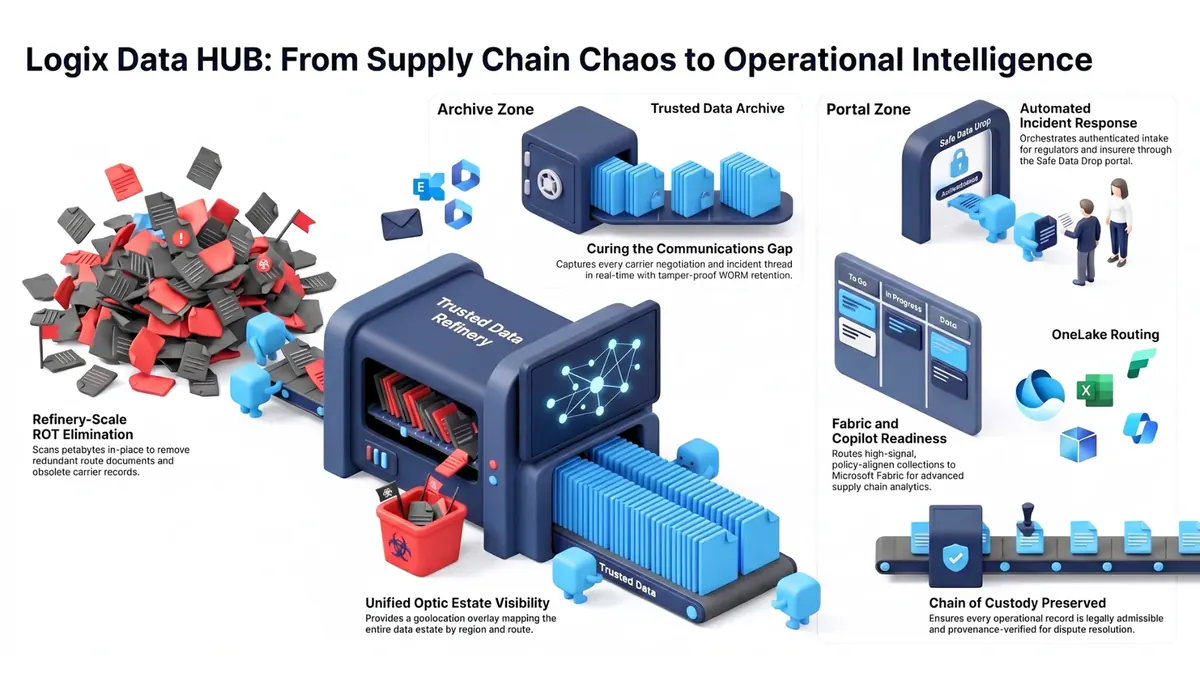
The Trusted Data Refinery scans Windows File Shares and SharePoint across the logistics environment, classifies and enriches every file object, eliminates ROT, and produces Trusted Data Collections organized by carrier, route, and region. Unified Optic provides a geolocation overlay that shows data concentrations across the operational network, giving logistics leadership visibility into the data estate that matches the operational visibility they already have over the supply chain.
"The analytical outputs reflect the noise in the underlying data."
Logix Data HUB Trusted Data Toolkit
Trusted Data Archive
Communications Governance
The Trusted Data Archive captures all Exchange and M365 communications in real time: carrier negotiations, incident correspondence, regulatory submissions, and operational communications, all preserved with complete envelope data, WORM-compliant storage, and a tamper-evident audit trail. Every communication is captured before it can be altered or deleted, with original timestamps and full routing metadata preserved. When a freight dispute requires the complete communications record between an operations team and a carrier, the Archive produces it with full chain of custody documentation.
Trusted Data Refinery
Operational Data Intelligence
The Trusted Data Refinery scans Windows File Shares and SharePoint in place at petabyte scale: carrier contracts, incident records, customs documentation, compliance filings, and operational correspondence, all classified, enriched with metadata, and curated into Trusted Data Collections scoped by route, region, carrier, or business unit. ROT elimination runs across the entire estate. Unified Optic provides a geolocation overlay showing exactly where data concentrations exist across regions and operational nodes.
Trusted Data Portal
Governed Intake and AI Activation
Workflow Builder manages incident response from trigger to resolution: when an incident is identified, the relevant data sources are preserved, the matter is scoped, and Trusted Data Collections are assembled for insurer or regulator review. Safe Data Drop provides governed intake for regulatory submissions and insurance claim documentation. Trusted Data Collections route to OneLake for Fabric-powered supply chain analytics and AI applications.
Logix Data HUB Briefing
Launch the interactive Smart Stack 3.0 executive briefing tailored for your industry.
Logix Data HUB
Powered by Smart Stack 3.0