
Smart Stack 3.0
Retail Data HUB
From consumer data chaos to AI-ready retail intelligence, governed and defensible.
Governing the Consumer Data Your Compliance Program Has Not Yet Reached
Retail organizations are managing a consumer data governance challenge that most have not fully confronted. PCI DSS, FTC requirements, and state-level privacy regulations focus compliance attention on structured transactional systems. But the actual concentration of unclassified consumer PII in most retail enterprises is not in the POS system or the e-commerce platform. It is in the Microsoft file environments that surround them: Windows File Shares full of customer correspondence, operational documents, and administrative records; SharePoint sites where regional and category teams store consumer-adjacent data without governance; and Exchange and M365 communications where supplier negotiations, HR matters, and customer escalations create a communications record that has never been properly archived.
Retail Data HUB applies Smart Stack 3.0 to the Microsoft data environments where retail governance risk and retail AI opportunity actually live. Not your POS. Not your e-commerce platform. The ungoverned unstructured data layer that compliance programs have not yet reached.
The Challenge
On-premise Windows File Shares in retail organizations accumulate consumer-adjacent data over years: customer escalation files, loyalty program correspondence, returns and refund records, HR documentation, and supplier contract repositories. PII is embedded throughout, in documents that were never classified, never reviewed for sensitivity, and never governed for retention. When a state AG investigation, FTC inquiry, or class action requires the organization to demonstrate PII control across its data estate, these environments are the hardest to defend.
SharePoint environments in retail have expanded rapidly with M365 adoption. Category management teams, regional operations, HR, and supplier management functions create sites and document libraries that accumulate sensitive content without data owners or retention policy. Consumer research, pricing strategy documentation, employee records, and supplier correspondence sit in SharePoint environments that have never been classified or governed.
Exchange and M365 communications carry the record of supplier negotiations, pricing discussions, HR matters, customer escalations, and legal correspondence. Without compliance-grade journal archiving, these communications are vulnerable. When a class action or regulatory inquiry requires the complete communications record around a specific pricing decision or customer matter, gaps in archiving create both evidentiary and litigation risk.
AI adoption in retail is accelerating. Copilot for M365, Fabric-powered demand forecasting, and merchandising intelligence applications all depend on data quality. When the underlying file share and SharePoint data contains unclassified PII, AI applications that consume it create new exposure rather than new intelligence. Governing the data before AI touches it is not optional.
The Unstructured File Estate Problem
Consumer PII is embedded in your file estate. It has never been detected.
Retail organizations have invested significantly in governing the structured systems that process consumer transactions. The unstructured file estate that surrounds those systems has received almost none of that attention. And consumer PII does not stay neatly inside the structured systems. It migrates into the file estate through the ordinary work of retail operations and stays there, undetected and unclassified, until a regulator or a breach investigator finds it.
A retail organization has file shares that reflect the operational reality of the business: customer escalation files saved by regional operations teams. Loyalty program correspondence downloaded and saved by marketing staff. Returns and refund documentation maintained by customer service. HR files containing employee health information and personnel decisions. Supplier contract repositories maintained by category management. All created in the ordinary course of retail operations, and none of it ever classified, never searched for PII, never subjected to the access controls that state privacy laws, PCI DSS, and FTC requirements demand.
SharePoint sprawl in retail mirrors the organizational structure of the business: sites for each category, each region, each functional team. Supplier negotiations from vendors the organization no longer works with. HR content accessible to more people than necessary. Consumer research documents containing identifiable information. None of it was created with malicious intent. It accumulated without governance.
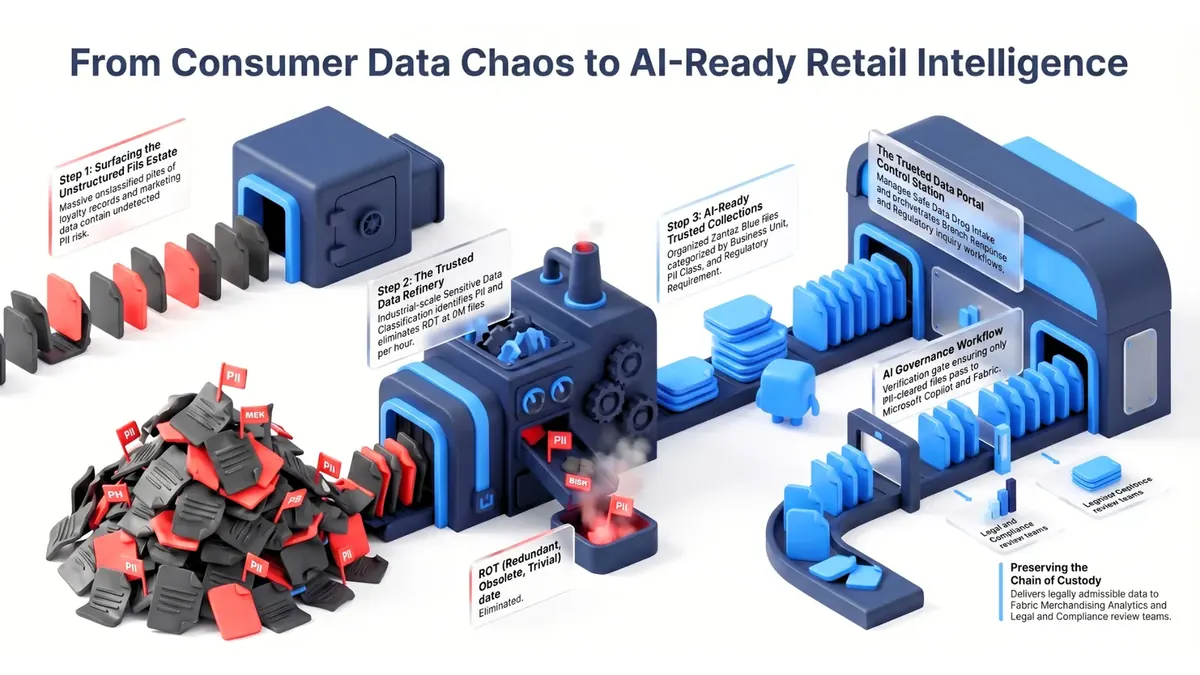
State AG investigations, FTC inquiries, and class action litigation increasingly focus on whether organizations know where consumer data lives and what controls apply to it. An organization that has never classified its file estate cannot answer those questions. The cost of that inability, in legal fees, regulatory penalties, and reputational damage, is significantly higher than the cost of governing the file estate proactively. The Trusted Data Refinery connects to Windows File Shares and SharePoint, applies Sensitive Data Classification to identify consumer PII, governs it in place, eliminates ROT, and produces Trusted Data Collections that are classified and governed before any AI application reaches them.
"Consumer PII does not stay neatly inside the structured systems. It migrates into the file estate through the ordinary work of retail operations."
Retail Data HUB Trusted Data Toolkit
Trusted Data Archive
Communications Governance
The Trusted Data Archive captures all Exchange and M365 communications in real time: supplier negotiations, HR correspondence, pricing strategy communications, customer escalation records, and legal correspondence, all preserved with complete envelope data, WORM-compliant storage, and a tamper-evident audit trail. When a regulatory inquiry or class action requires the complete communications record around a specific period, decision, or custodian, the Archive produces it with full chain of custody documentation and the evidentiary integrity that legal proceedings require.
Trusted Data Refinery
Operational Data Intelligence
The Trusted Data Refinery scans Windows File Shares and SharePoint in place: consumer-adjacent files, HR documentation, supplier contracts, and operational records, all classified for PII using Microsoft Presidio and pattern matching. Consumer names, addresses, account identifiers, and other PII embedded in unstructured files are detected and flagged before any AI application touches them. ROT elimination runs across the entire estate. Trusted Data Collections assembled by business unit, custodian, or regulatory obligation: clean, classified, and AI-ready.
Trusted Data Portal
Governed Intake and AI Activation
Safe Data Drop provides governed intake for regulatory submissions, legal matters, and internal compliance inquiries. AI Governance Workflow ensures only PII-cleared, policy-aligned Trusted Data Collections reach Copilot and Fabric applications. Trusted Data Collections route to OneLake for Fabric-powered merchandising intelligence, demand forecasting, and supplier analytics. Clean, classified, provenance-aware data that AI applications can reliably and defensibly consume.
Retail Data HUB Briefing
Launch the interactive Smart Stack 3.0 executive briefing tailored for your industry.
Retail Data HUB
Powered by Smart Stack 3.0