
Smart Stack 3.0
Vita Data HUB
Patient-safe. Audit-ready. AI-ready. The trusted data layer for modern healthcare.
Executive Conversation
Healthcare AI Readiness
A short, phone-friendly briefing on preparing enterprise data for AI once, then reducing both existing data costs and future AI compute costs.
Read the briefingInteractive Presentation
Healthcare Data Operationalization in Action
A full-screen, scroll-driven walkthrough of the operational gap between Microsoft connectivity and Microsoft governance, and how Smart Stack 3.0 closes it.
Governing the Unstructured Data That Surrounds Every Patient Record
Healthcare CIOs and compliance officers are rightly focused on the structured clinical environments: Epic, Cerner, the EHR, the ERP. But the data governance crisis in healthcare does not live in those systems. It lives in the Microsoft environments that surround them. The file shares where clinical documentation, administrative records, and operational files have accumulated for years. The SharePoint sites where departmental teams store patient-adjacent data without governance. The Exchange and M365 communications environment where PHI moves through email every day, often without the retention controls HIPAA requires.
Vita Data HUB applies Smart Stack 3.0 specifically to these environments. Not Epic. Not your EHR. The ungoverned Microsoft data layer that your structured systems depend on and that your compliance program has not yet reached.
The Challenge
On-premise Windows File Shares in healthcare organizations frequently contain years of clinical administration files, departmental records, HR documentation, credentialing files, and operational correspondence. PHI is embedded throughout, in documents that were never classified, never governed for retention, and never reviewed for sensitivity. A HIPAA audit that reaches these environments will find PHI exposure that the organization cannot fully account for.
SharePoint Online has expanded rapidly with M365 adoption in healthcare. Clinical departments, administrative teams, and operational units create team sites and document libraries that accumulate sensitive content without data owners, without retention policies, and without any classification layer. Patient-adjacent documents, insurance correspondence, referral records, and administrative communications sit in SharePoint environments that have never been systematically governed.
Exchange and M365 email is where PHI moves daily: referral communications, administrative correspondence, insurance authorizations, HR communications with employee health data, and clinical coordination emails. Microsoft 365 retention features do not deliver evidentiary-grade, immutable archiving. When an OCR audit requests a complete communications record, gaps in journaling and incomplete envelope preservation create compliance exposure.
Microsoft Teams has accelerated the problem. Clinical and administrative teams communicate through Teams daily, generating a persistent record of communications that must be governed under the same HIPAA standards as email. Many organizations have not extended their archiving and governance posture to Teams.
AI ambition in healthcare is significant. Copilot for M365 and Fabric-powered clinical analytics require data that is clean, governed, and PHI-aware. When the underlying file share and SharePoint data has never been classified or had PHI detected and controlled, AI adoption creates new exposure rather than new value.
The Unstructured File Estate Problem
PHI is in your file shares and SharePoint. It has never been classified.
Healthcare organizations invest heavily in governing the structured clinical systems, the EHR, the practice management platform, the revenue cycle system. Those systems are well controlled. The unstructured file estate that surrounds them is not. PHI does not stay neatly inside the structured systems. It migrates into file shares and SharePoint through the ordinary work of clinical administration, and it stays there, undetected and unclassified, until a regulator or a breach investigator finds it.
Clinical department file shares hold documentation that references patient cases in ways that are operationally necessary but were never treated as regulated data. HR file shares hold employee health information in forms, correspondence, and benefits documentation. Revenue cycle file shares hold claim documentation, explanation of benefits records, and patient financial information. None of this was created with the intention of violating HIPAA. The governance failure is that it was never classified, never access-controlled beyond basic folder permissions, and never subjected to the PHI identification process HIPAA requires.
SharePoint in healthcare has expanded with M365 adoption in administrative and operational functions. Departmental team sites accumulate documents that reference patient care in ways that are common in administrative contexts: scheduling coordination documents, department meeting notes that reference specific cases, quality review documents that identify patients by name. These documents live in SharePoint sites with no governance, accessible to more people than necessary, and have never been reviewed for PHI content.
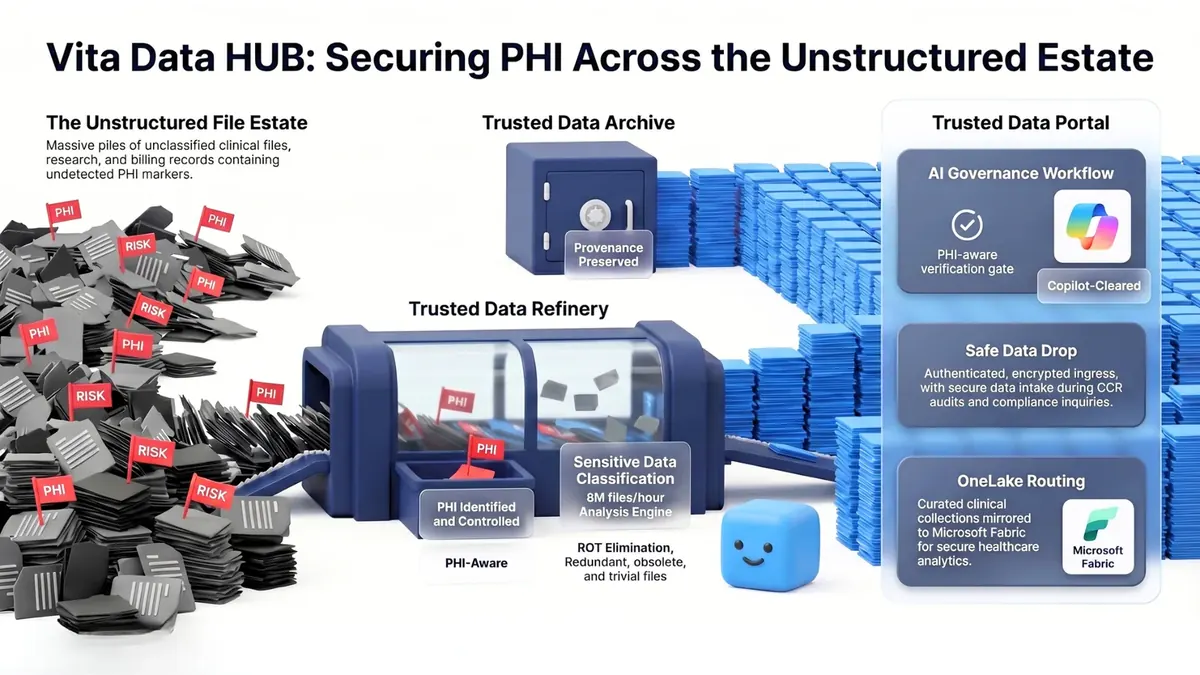
OCR audits and breach investigations consistently find PHI in locations the organization did not expect. The cost of a HIPAA breach, OCR penalties, remediation costs, reputational damage, is a fraction of what a systematic governance program costs. The Trusted Data Refinery scans Windows File Shares and SharePoint, identifies PHI using Sensitive Data Classification, governs it in place, and produces Trusted Data Collections that are PHI-aware and AI-ready.
"PHI does not stay neatly inside the structured systems. It migrates into file shares and SharePoint through the ordinary work of clinical administration."
Vita Data HUB Trusted Data Toolkit
Trusted Data Archive
Communications Governance
The Trusted Data Archive captures all Exchange and M365 communications, including Teams, in real time through compliance-grade journal archiving. Every communication is preserved with complete envelope data, original timestamps, and tamper-proof WORM storage. PHI that moves through email and Teams is preserved under a defensible, immutable retention framework that meets HIPAA requirements and survives OCR audit scrutiny. Every access, export, and classification event is recorded in a tamper-evident audit trail.
Trusted Data Refinery
Operational Data Intelligence
The Trusted Data Refinery scans Windows File Shares and SharePoint in place, detecting PHI across the unstructured file estate without moving data until it is classified and trusted. Microsoft Presidio and pattern matching identify PHI: patient names, medical record numbers, insurance identifiers, date-of-birth combinations, and other protected health information embedded in files that were never intended to be governed. ROT data is identified and flagged. Trusted Data Collections assembled by department, custodian, or care pathway carry a complete classification record for every file. Unified Optic gives compliance leadership a complete picture of where PHI concentrations exist across the estate.
Trusted Data Portal
Governed Intake and AI Activation
Safe Data Drop provides authenticated, encrypted intake for compliance inquiries, regulatory submissions, and internal governance workflows. The AI Governance Workflow is the control layer for Copilot and Fabric adoption in healthcare: before any data set reaches a clinical AI application or analytics pipeline, it is validated for PHI awareness and policy alignment. Only Trusted Data Collections that have been classified and cleared for AI consumption pass through. Chain of custody and provenance are preserved for every data set surfaced to AI systems.
Vita Data HUB Briefing
Launch the interactive Smart Stack 3.0 executive briefing tailored for your industry.
Vita Data HUB
Powered by Smart Stack 3.0