
Part 4 of 4
Copilot Is Waking Up SharePoint's Dark Data
Microsoft agents can understand information buried inside scanned files, images, charts, diagrams, lists and metadata. Years of dormant content are becoming active AI knowledge.
Companion Video
In This Part
- Microsoft agents can now read scanned files, images, charts, diagrams and lists.
- Content that sat dormant for years is suddenly influencing AI answers.
- Visibility is not readiness, so the content has to be prepared before it becomes AI knowledge.
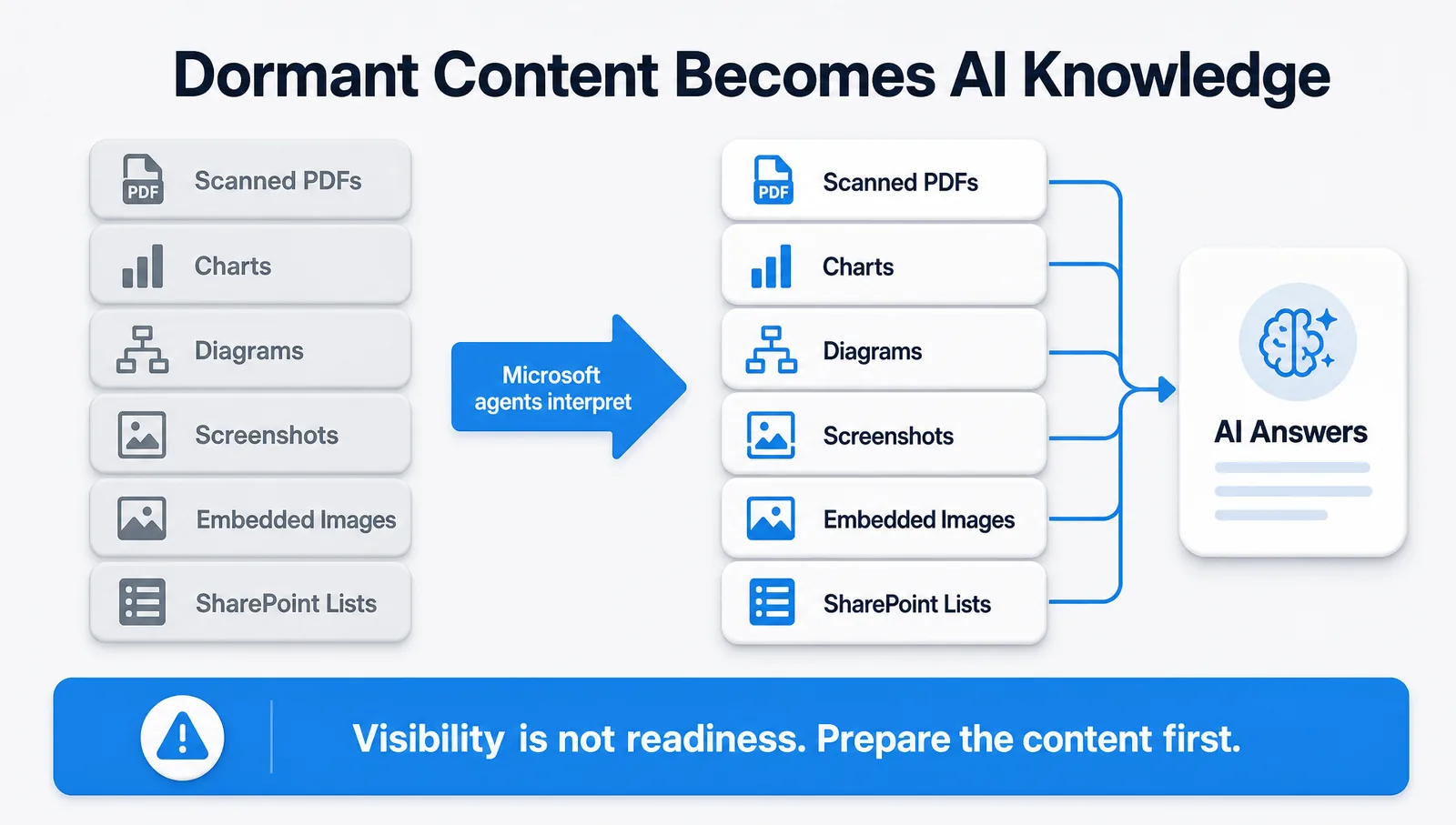
Visibility is not readiness. Prepare the content first.
SharePoint's data expansion is not limited to new content. Microsoft is making existing content more understandable to Copilot and agents. Information that previously remained difficult to search or analyze can now influence AI-generated answers and decisions. This includes information contained in:
- Scanned PDFs
- Image-based documents
- Charts
- Diagrams
- Screenshots
- Images embedded in Word files
- PowerPoint visuals
- SharePoint Lists
- Modern SharePoint pages
- File and library metadata
The effective data estate is expanding even when the file count remains unchanged.
Microsoft Agents Can Now Interpret Embedded Images
Microsoft 365 declarative agents can ground responses in images embedded inside Word, PowerPoint and PDF files. Microsoft specifically identifies charts, diagrams and screenshots as content that agents can now use to produce more complete answers. The feature is documented under Roadmap ID 531758.
Microsoft also announced that newly created declarative agents can ground answers in scanned PDFs and image-based documents stored in SharePoint.
This is a major change for legacy enterprise data. Contracts, forms, historical correspondence, technical drawings, reports and presentation materials can contain critical information that never appeared in searchable text or reliable metadata. AI can now reach more of it.
SharePoint Lists Are Becoming AI Knowledge Sources
Microsoft agents can also use selected SharePoint Lists as structured knowledge sources. The current documented limit is 20,000 items or 50 MB of raw text. Lists exceeding either threshold are truncated. Attachments and lookup columns are not currently used for grounding, and selecting the containing site does not automatically include its lists. This activates another substantial class of enterprise information:
- Issue trackers
- Asset registers
- Project records
- Approval logs
- Customer lists
- Risk registers
- Policy inventories
- Departmental operating data
Structured SharePoint data can now inform conversational AI without first being rebuilt as a traditional database application.
Visibility Is Not the Same as Readiness
The ability to interpret more content creates value. It also activates risk.
A scanned contract can contain signatures, pricing and confidential terms without an appropriate sensitivity label. A presentation can contain material financial information inside a chart that text-based classification never detected. A screenshot can reveal personal information, credentials or customer data. A legacy diagram can describe an obsolete technical architecture. A SharePoint List can contain incomplete or inconsistent records that appear authoritative because they are structured.
Microsoft's retrieval capability determines what the AI can understand. It does not establish that the information is current, complete, properly classified or appropriate for the use case.
The Zantaz Response: Prepare the Content Before It Becomes AI Knowledge
The Trusted Data Refinery provides the upstream preparation layer. It identifies redundant and superseded content, detects sensitive information, applies or recommends classifications, evaluates age and activity, preserves source provenance, records policy conditions and separates useful information from ROT.
Expanded classification
Strengthens the preparation layer by combining Microsoft Presidio, custom recognizers and zero-shot classification approaches rather than relying on a single detection method.
MIP Mapper
Uses Refinery classifications to recommend the appropriate Microsoft Information Protection sensitivity label. Microsoft remains the enforcement environment.
Trusted Data Collections
Lets approved content be defined once and carry its source, permissions, classifications, policies and history into approved AI and analytics experiences.
Foundry Lens
Provides the complementary visibility layer by showing which enterprise sources support an agent and resolving those sources back to their canonical SharePoint, OneDrive, file-share or OneLake locations.
The enterprise opportunity is substantial. Copilot can help organizations recover knowledge from content that has remained dormant for years. That can improve research, customer service, legal analysis, product development, operations and institutional continuity.
The enterprise risk is equally clear. AI can also reactivate obsolete, sensitive, duplicated and poorly governed information. The answer is not to prevent Microsoft from understanding the content. The answer is to prepare the content so the expanded intelligence produces reliable results.
Microsoft is making more enterprise data visible to AI. Zantaz ensures that the data deserves to influence the answer.
Verified Foundation
- Declarative agents can interpret embedded images in DOCX, PPTX and PDF files.
- Microsoft specifically names charts, diagrams and screenshots.
- Microsoft announced grounding from scanned PDFs and image-based SharePoint documents in February 2026.
- SharePoint Lists can serve as agent knowledge sources, subject to documented size and feature limits.
Microsoft Documentation
The SharePoint Playbook Conclusion
- Copilot makes SharePoint environments and content easier to create.
- Teams converts daily meetings into persistent enterprise information.
- Microsoft agents activate previously dark and underused content.
Smart Stack 3.0 turns that expansion into trusted business value through visibility, classification, lifecycle governance, authoritative collections and controlled execution. Microsoft expands what enterprise AI can reach. Zantaz makes the expanded estate ready.
See what Microsoft's SharePoint expansion means for your enterprise data estate.