
Part 2 of 4
Microsoft Just Made SharePoint Data Sprawl Effortless
Copilot can now turn a natural-language request into a working SharePoint environment. Enterprise data creation is about to accelerate.
Companion Video
In This Part
- A single Copilot request can now stand up a full SharePoint environment with sites, lists and workflows.
- Creation is no longer gated by IT, so environments multiply faster than ownership and lifecycle rules.
- A Trusted Foundation Review checks the source data before the new environment is built on it.
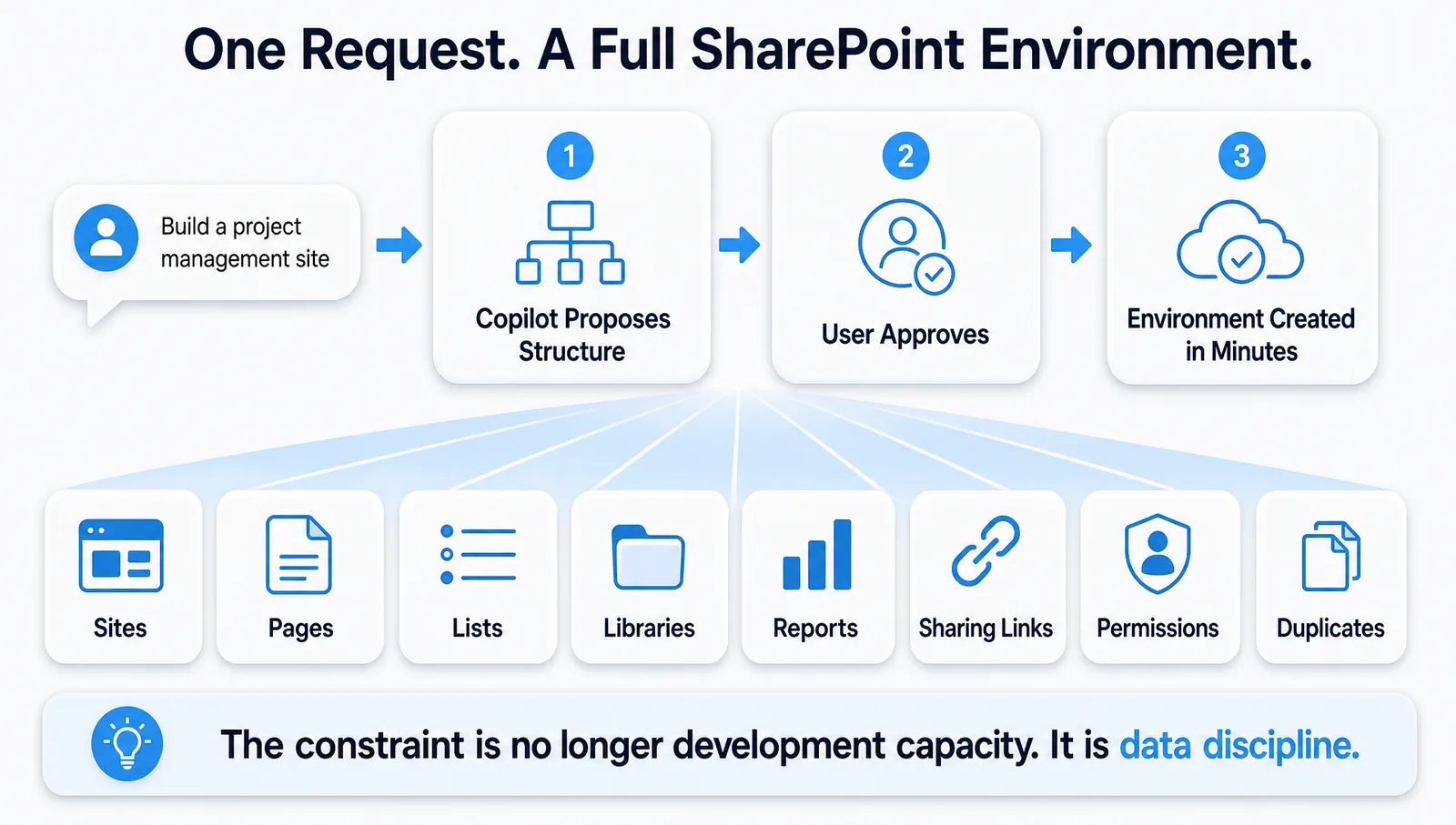
The constraint is no longer development capacity. It is data discipline.
- "Build a project management site for our product launch."
- "Create a customer onboarding workspace."
- "Build a policy center with an approval tracker."
- "Create an interactive report from these files."
Those instructions can now initiate the creation of SharePoint sites, pages, lists, libraries, reports, Office files and workflows. Microsoft calls this Copilot in SharePoint. The larger consequence is the democratization of enterprise application and data creation.
Every Copilot User Can Become a SharePoint Builder
Microsoft's new SharePoint experience allows a user to describe a business requirement in natural language. Copilot recommends the solution structure, including pages, lists and libraries. The user can refine the plan through chat and approve its creation.
Microsoft then creates the environment in minutes.
This will allow business teams to move faster. It will also multiply the number of environments that require ownership, security, lifecycle management and reliable data.
The historic constraint was development capacity. The new constraint is data discipline.
The New SharePoint Sprawl
Traditional SharePoint sprawl accumulated gradually. Teams created sites, copied documents, changed personnel and left aging workspaces behind. Copilot changes the speed of that cycle. Organizations should expect growth across:
- Sites and subsites
- Pages and libraries
- Lists and structured records
- Reports and dashboards
- Workflow outputs
- Copilot-generated documents
- Sharing links
- Unique permissions
- Departmental taxonomies
- Duplicate sources of truth
AI will also make an attractive solution easier to create than an authoritative one.
A site can look polished while relying on obsolete policies. A dashboard can appear decisive while drawing from duplicated data. A workflow can operate correctly while using an improperly classified source.
Creation quality and data quality are not the same thing.
Five Questions Every AI-Created Site Must Answer
Before an AI-created SharePoint environment becomes operational, the organization should establish:
01
Purpose
What business process or decision will this environment support?
02
Authority
Which sources are approved and which version is controlling?
03
Ownership
Who owns the environment, its data and its ongoing review?
04
Access
Who can view, edit, share or use the data through Copilot?
05
Lifecycle
When will the site and its content be reviewed, archived or deleted?
Microsoft supplies the creation experience. The enterprise remains responsible for these decisions.
The Zantaz Response: Trusted Data Before AI Construction
Zantaz can introduce a Trusted Foundation Review for new SharePoint and Copilot environments. Before a customer builds, Smart Stack can evaluate the proposed source data.
Trusted Data Refinery
Identifies duplicate and superseded documents, sensitive or unclassified content, inactive sources, conflicting metadata and content that should not be copied into the new environment.
Trusted Data Lens
Surfaces broad or external access, missing ownership, retention coverage and Legal Hold conditions across the proposed sources, read-only and tenant-wide.
Trusted Data Collections
Packages the approved sources with their permissions, classifications, policies, provenance and history, so the new site starts from a defined and governed information foundation.
The answer to AI-assisted creation is not to stop employees from building. The value lies in giving them approved data foundations, clear ownership and reusable governance.
That creates a practical division of responsibility. Microsoft accelerates the user's ability to build. The business defines the purpose and ownership. Zantaz prepares and governs the underlying data. Microsoft and Purview enforce the customer's approved permissions and policies.
Microsoft has reduced the cost of creating SharePoint solutions. Zantaz reduces the risk and data debt created when those solutions scale.
Verified Foundation
- AI-assisted SharePoint site creation is currently documented as a preview capability.
- Copilot creates the site only after the user reviews and approves the proposed plan.
- Microsoft confirms that the generated structure can include pages, lists and libraries.
- The projected acceleration of sprawl is an evidence-based Zantaz inference. Microsoft has not published a forecast quantifying how many additional sites Copilot will create.
Microsoft Documentation
Next in the Playbook
AI is expanding SharePoint through creation. Microsoft Teams is producing another expansion through everyday conversation. Part Three examines how every recorded meeting is becoming a new enterprise data asset.
Read Part 3: Every Teams Meeting Is Becoming a Data FactorySee what Microsoft's SharePoint expansion means for your enterprise data estate.